Digital tools may accelerate introductions, but lasting Africa–Caribbean commerce still depends on trust built in person, writes David F. Roberts. Published on: The Africa Briefing
IN an era dominated by artificial intelligence, virtual meetings, digital marketplaces and instant global communication, it is reasonable to ask whether trade missions have become obsolete.
If businesses can connect through Zoom, negotiate contracts by email and reach prospective buyers through online platforms, why invest the time and money required to travel across continents?
The answer is straightforward: technology accelerates introductions, but relationships build economies.
Nowhere is that distinction more important than in the emerging commercial partnership between Africa and the Caribbean. Trust, cultural understanding and sustained collaboration remain essential to turning shared ambitions into viable businesses, investments and institutions.
At the African Caribbean Sustainability & Investment Initiative (ACSII), we therefore see trade missions not as relics of an earlier age, but as practical instruments for shaping the next phase of South–South cooperation.
Beyond the video call
Digital platforms have transformed international business. A government minister in Barbados can speak with investors in Lagos within minutes. Entrepreneurs in Jamaica can present their products to prospective buyers in Ghana without leaving their offices.
These capabilities are invaluable, particularly for smaller businesses that might otherwise struggle to access overseas markets.
Yet digital convenience does not eliminate the need for confidence between potential partners. Major investments are rarely secured through one online presentation. They usually emerge from repeated conversations, site visits, due diligence, introductions to trusted local partners and a deeper understanding of the political, cultural and commercial environment.
Trade missions can compress months of relationship-building into a few carefully organised days. They bring decision-makers into the same room, allow businesses to assess potential partners directly and create opportunities that may never emerge from an unsolicited email or video call.
The value lies not merely in physical presence, but in purposeful access.
A changing global economy
Strategic engagement has become more important as geopolitical tensions, conflicts and protectionist policies reshape international trade.
Artificial intelligence is also transforming industries at extraordinary speed, creating opportunities for some businesses while threatening to leave others behind.
These pressures carry significant risks. They also provide an opening for regions willing to diversify their commercial relationships.
That urgency is reflected in CARICOM’s renewed drive to deepen trade and financial ties with Africa. As traditional partnerships become less predictable, Africa and the Caribbean have an opportunity to build commercial relationships based on complementary capabilities, shared interests and mutual respect.
Building a viable economic corridor
This is the thinking behind ACSII’s effort to develop practical mechanisms that bring the two regions closer together.
One such proposal is the Nigeria–CARICOM Trade Corridor. Nigeria, Africa’s most populous country and one of its largest economies, offers considerable entrepreneurial energy, manufacturing capacity and a rapidly developing technology sector.
CARICOM countries offer financial and professional services, tourism expertise, maritime access and growing opportunities in renewable energy, logistics, agriculture and the creative industries.
These strengths may be complementary, but they will not connect automatically. Historical and cultural ties alone cannot produce sustainable trade.
Businesses need market intelligence, finance, reliable transport links, appropriate regulation and credible local partners. Governments and institutions must also remove practical obstacles, including restrictive visa arrangements, weak air and maritime connectivity, payment difficulties and limited knowledge of each other’s markets.
Trade missions can help identify these barriers while connecting the people capable of addressing them.
Barbados as a regional bridge
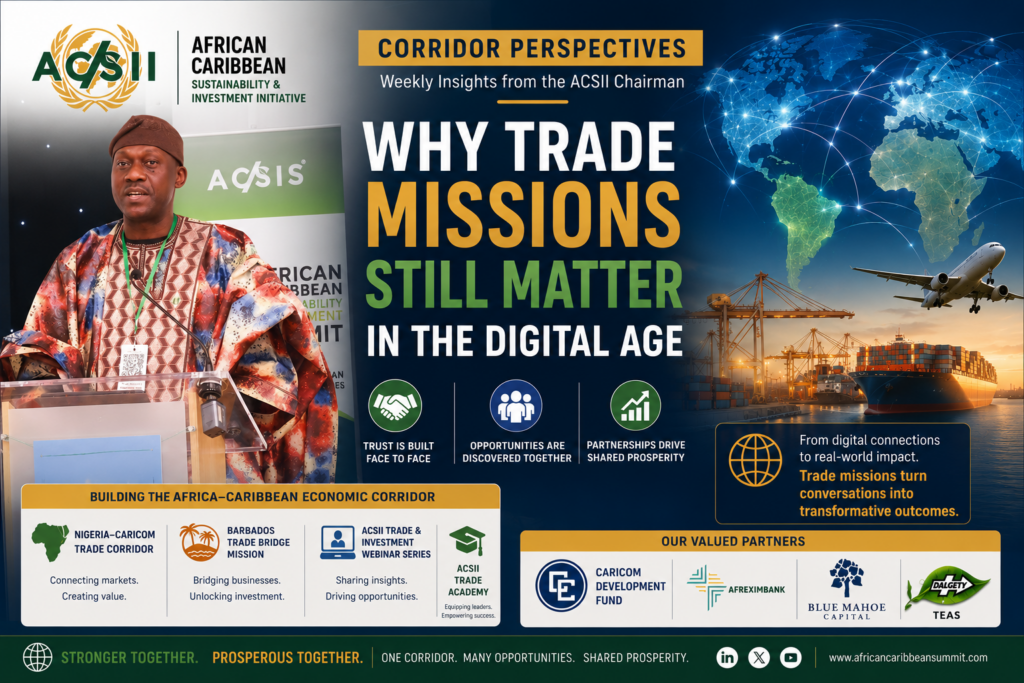
This approach underpins the ACSII Trade-Bridge Mission to Barbados, scheduled for September 22–25, 2026.
Barbados is a respected international business jurisdiction and a practical base from which companies can engage partners across CARICOM, although entry into individual markets remains subject to national and regional rules.
Its professional services, stable institutions and regional relationships make it a credible location from which African and UK businesses can explore opportunities across the Caribbean.
The mission aims to connect selected businesses with Barbadian and regional stakeholders through pre-arranged meetings, investment discussions and institutional engagement.
Success, however, should not be measured by the size of the delegation or the number of business cards exchanged. It must be judged by partnerships formed, contracts advanced, investments mobilised and projects eventually delivered.
That distinction matters because not every trade mission produces value.
Missions fail when they become ceremonial tours, when delegates are poorly matched or when there is no follow-up after the closing reception. A credible mission requires participant screening, clear sector priorities, realistic objectives and a system for tracking discussions after delegates return home.
The handshake may begin the relationship, but disciplined follow-through determines whether it survives.
Combining physical and digital engagement
The future of international commerce is neither exclusively physical nor entirely digital. It is a combination of both.
Digital platforms should prepare businesses for face-to-face meetings and maintain momentum afterwards. They can support preliminary discussions, due diligence, training and regular contact between partners who cannot travel frequently.
ACSII’s planned Trade and Investment Webinar Series is intended to provide year-round engagement among policymakers, entrepreneurs, investors and development professionals. Rather than replacing physical missions, the webinars will help participants identify opportunities before travelling and continue discussions after a mission ends.
The proposed ACSII Trade Academy has a different but complementary purpose. It is intended to help business leaders strengthen their knowledge of export readiness, investment promotion, international trade procedures, project preparation and cross-border partnerships.
This matters because access alone is insufficient. An entrepreneur introduced to an investor must still present a credible business case. A company entering a new market must understand its regulations, customers and commercial risks.
Physical engagement creates trust. Digital infrastructure sustains it. Practical training improves the likelihood that a promising introduction becomes a viable transaction.
Partnerships must produce results
No single organisation can build an international trade corridor.
The CARICOM Development Fund joined the African Caribbean Sustainability and Investment Summit as a programme partner and sponsor, while Afreximbank also supported the summit, according to ACSII. Their involvement reflected broader institutional interest in stronger commercial engagement between the two regions.
That momentum has continued, Afreximbank raising its CARICOM financing cap to $5bn to support infrastructure, trade and value-added industries.
ACSII deputy chairman David Mullings, founder of Blue Mahoe Holdings, whose businesses include Blue Mahoe Capital, also brings experience in investment, capital mobilisation and Caribbean markets to the initiative.
Such relationships should not be treated simply as endorsements. Their real value will be determined by whether they help businesses secure finance, enter new markets and complete projects.
The same test applies to the wider Africa–Caribbean relationship. Conferences and declarations create visibility, but implementation creates economic value.
A practical era of South–South cooperation
For decades, African and Caribbean economies have looked primarily towards Europe and North America for trade, investment and development partnerships.
Those relationships will remain important. However, stronger links within the Global South can give both regions greater resilience and more commercial options.
Africa brings expanding consumer markets, agricultural capacity, manufacturing potential, natural resources and a young population. The Caribbean contributes expertise in financial services, tourism, maritime logistics, creative industries and international business, alongside its strategic location between North and South America.
Together, these strengths can support joint ventures in renewable energy, fintech, agribusiness, healthcare, education, infrastructure, sustainable tourism, technology and the blue economy.
Recent initiatives, show that private-sector and government interest is beginning to move beyond cultural solidarity towards structured economic engagement.
Trade missions are often where those practical conversations begin.
Looking ahead
The digital age has made communication easier than at any previous point in history. It has not made trust easier to establish.
Successful international partnerships still depend on personal relationships, cultural understanding, credible institutions and confidence in the ambitions of those involved.
Technology will continue to transform how businesses meet, communicate and complete transactions. But it cannot fully replace visiting a proposed investment site, examining a market first-hand or sitting across the table from a potential business partner.
Trade missions remain valuable because they bring people together with a clear commercial purpose. Their future depends on better preparation, carefully selected participants and measurable follow-through.
For ACSII, they are not simply events. They are investments in the relationships required to turn the idea of an Africa–Caribbean economic corridor into a functioning commercial network.
The corridor will not be built by speeches alone. It will be built when people meet, establish trust and begin the difficult work of delivering together.
 David F. Roberts MSc is founder and chairman of ACSII, which is organising the Trade-Bridge Mission to Barbados discussed in this op-ed.