Africa and the Caribbean need education systems that build critical thinkers, innovators and problem-solvers for changing.
Keypoints:
- Education must move beyond memorisation
- Practical learning can strengthen graduate skills
- Africa-Caribbean cooperation can deepen innovation
AFRICA and the Caribbean face a common education challenge: how to prepare young people for economies in which jobs, technology and society are changing faster than traditional classrooms can easily keep pace.
The issue goes beyond getting more people into education. Increasingly, the question is whether what students learn equips them to think independently, adapt to change and solve problems they may never have encountered before.
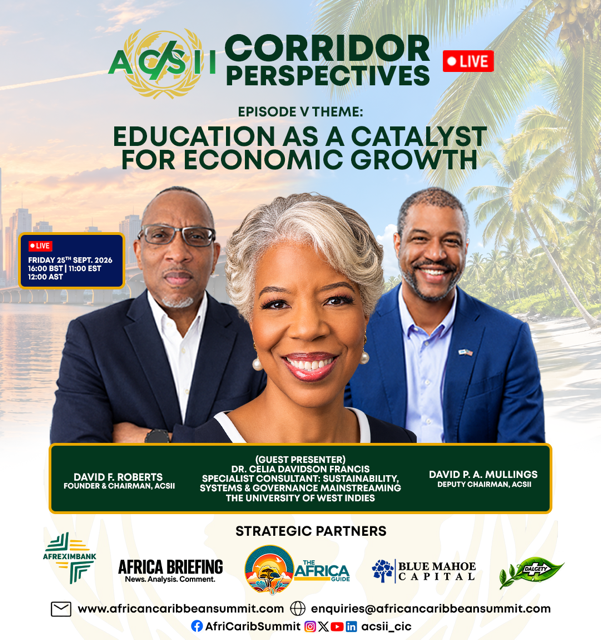
That was at the centre of Episode V of Corridor Perspectives – LIVE, which examined how education could become a stronger catalyst for economic growth across Africa and the Caribbean.
Dr Celia Davidson Francis, Specialist Consultant: Sustainability, Systems & Governance Mainstreaming, argued that education should do more than prepare people for employment.
It should also prepare them to think, adapt, communicate, innovate, lead and solve problems.
That matters because no education system can say with certainty what the job market will look like in 10 or 20 years. Training young people only for the jobs that exist today could leave them struggling to adjust to the economies they will eventually have to navigate.
Learning how to think
For many students, education is still closely tied to memorising information, passing examinations and earning qualifications.
Francis’s point was not that academic knowledge no longer matters. It was that knowledge on its own is not enough.
Students also need to know how to question information, think critically, communicate clearly, make sound judgements and understand problems that do not have simple answers.
Those abilities become even more important when technology changes the workplace or when communities face challenges that cannot be solved by following a familiar formula.
The debate comes as education is becoming an increasingly important public concern across Africa, alongside unemployment and growing pressure on governments to turn years spent in school into real economic opportunity.
The challenge, then, is not simply whether young people have access to education. It is whether that education leaves them ready to contribute meaningfully to changing societies and economies.
Taking learning beyond the classroom
That also means bringing education closer to the real world.
Internships, job-shadowing, workplace attachments and stronger partnerships between universities and businesses can help students understand how ideas work outside the classroom.
A placement gives a student more than something to add to a CV. It shows them how organisations operate, how teams respond to problems and why ideas often need to be adjusted when they meet real-world pressures.
Employers can benefit too. Students bring fresh perspectives, while businesses can help schools and universities understand how skills needs are changing.
The same question sits behind the wider African debate over technical and vocational education and the effort to connect learning more closely with employment.
Education works best when it is not cut off from the economy it is meant to serve.
Knowledge does not begin with a degree
One of the strongest parts of the discussion focused on people who may never have gone to university.
Communities carry knowledge built through experience. Farmers understand the land they work. Traders understand their markets. Artisans know their tools, materials and techniques. People living with a problem every day often understand it in ways that outside experts do not.
That knowledge should not be dismissed simply because it does not come with a formal qualification.
Francis suggested a different way for institutions to approach communities:
‘What problem are you experiencing? How have you tried to solve it? How can we help?’
Those questions change the relationship.
Instead of arriving with a ready-made answer, institutions begin by listening.
That matters because solutions designed without a clear understanding of how people actually live can look convincing on paper and still fail in practice.
The broader lesson is that expertise also requires humility — and knowing when someone else understands the problem better than you do.
Preparing young people for bigger challenges
The conversation also moved into climate change, misinformation, governance and leadership.
These issues can sound distant when taught only as broad concepts. In reality, their effects are often very personal.
Climate pressures can affect food, incomes and migration. Misinformation can influence decisions inside families and communities. Governance shapes public services, business confidence and economic opportunity.
Education becomes more valuable when young people can see those connections and understand how wider forces affect their own lives.
But Francis also argued that young people should not simply be told what the solutions are. They need space to help find them.
That means encouraging curiosity, debate, experimentation and problem-solving rather than treating students only as people who receive information.
Africa and Caribbean can learn together
There is also room for Africa and the Caribbean to learn more from each other.
Both regions are trying to build stronger economies while dealing with skills shortages, limited resources, climate pressures and fast-moving technological change.
Sharing research, teaching methods, innovation and practical experience could help institutions avoid repeating the same mistakes and make better use of limited resources.
That fits into a wider conversation about building stronger Africa-Caribbean economic and knowledge links, as relations between the two regions increasingly move beyond shared history towards practical cooperation.
It also reflects SDG 17, Partnerships for the Goals, which places knowledge-sharing, technology and cooperation at the heart of sustainable development.
The wider message from Corridor Perspectives – LIVE was simple.
An education system should not be judged only by how many graduates it produces.
It should also be judged by whether those graduates can face an unfamiliar problem, think through it and decide what to do next.
Africa and the Caribbean will need workers, certainly. But they will also need entrepreneurs, innovators, ethical leaders and citizens who can adapt when the world around them changes.
That is where education becomes more than preparation for a job.
It becomes part of the foundation of economic growth.
Watch the full Corridor Perspectives – LIVE Episode V discussion on education and economic growth.
Next on Corridor Perspectives – LIVE
Episode VI, The Commonwealth’s Role in Strengthening Trade, features Dr Ngozi Oyewole, President of Commonwealth Business Women Africa, on Friday, October 2, 2026, at 16:00 BST | 11:00 EDT.
Join Corridor Perspectives – LIVE Episode VI on YouTube.
For more articles on Africa: The Africa Briefing – https://africabriefing.com/