
Diaspora investment needs trust, transparency and credible structures to turn remittances into long-term wealth
Keypoints:
- Trust remains critical to diaspora investment
- Ownership can build wealth beyond remittances
- Credible structures can reduce investment risks
DIASPORA communities across Africa and the Caribbean could become a much larger source of productive capital if governments, financial institutions and businesses build credible investment channels capable of turning savings into ownership.
That was the central argument from Episode IV of Corridor Perspectives – Live, which examined how diaspora capital can move beyond household remittances towards equity, productive investment and intergenerational wealth. The discussion featured Akwasi Agyeman, chief executive officer of the Africa Centre for Hospitality, Aviation, and Tourism (AfCHAT).
The stakes are substantial. World Bank data show personal remittances received were equivalent to 3.2 percent of Sub-Saharan Africa’s GDP in 2024. The emerging question is whether some diaspora savings can also be channelled into businesses and assets without weakening remittances’ essential role in supporting households.
Trust before capital
The Episode IV post-event report identified trust as the foundation of any serious diaspora investment strategy.
Investors may have emotional and family connections to their countries of origin, but those ties do not remove concerns about governance, transparency, regulation or whether commitments will be honoured.
That concern mirrors a wider Africa-Caribbean commercial challenge. Africa Briefing recently reported that trust, finance and stronger institutions are becoming central to efforts to turn historic ties between the two regions into repeatable business.
For diaspora investors, the questions are practical: who manages the money, what safeguards exist, how transparent is the investment and what happens when a project underperforms?
From remittances to ownership
The discussion argued that diaspora engagement should move beyond the familiar language of ‘sending money home’ towards owning assets and businesses.
That does not mean household remittances should simply be redirected into investment. Remittances frequently pay for food, education, housing and healthcare. Investment requires separate capital, longer time horizons and acceptance of financial risk.
The opportunity lies in creating credible vehicles that allow diaspora savers to participate voluntarily in professionally managed funds, companies, infrastructure and other productive assets.
Africa Briefing has previously examined the case for turning diaspora wealth into ownership, arguing that transparent governance and investable opportunities are necessary to connect diaspora ambition with productive capital.
There are precedents. A World Bank report notes that Nigeria raised $300m through a diaspora bond in 2017, with the issue oversubscribed by 130 percent — evidence that diaspora savings can be mobilised at scale when investment structures are credible.
Risk needs real safeguards
Episode IV also highlighted due diligence, accountability and risk mitigation as necessary conditions for investment.
One participant observed that some Caribbean nationals left their countries partly because opportunities were limited. Encouraging them to return as investors can therefore mean confronting perceptions of the same systems or business conditions they once chose to leave.
The post-event report captured the challenge succinctly: diaspora investment cannot simply be requested — trust must be rebuilt.
That argument comes as CARICOM deepens trade and financial links with Africa and institutions seek to give greater commercial substance to the Africa-Caribbean relationship.
Building an investment corridor
The emerging model can be reduced to a sequence: trust, transparency, risk mitigation, investment, ownership and wealth creation.
For governments and institutions, the implication is significant. Diaspora communities should not be viewed merely as sources of foreign exchange. Properly governed pathways can allow them to become shareholders, entrepreneurs and long-term investors.
That wider commercial push is already visible in initiatives including the Africa-Caribbean trade and investment mission in Barbados, which is bringing investors, businesses and policymakers together around cross-border opportunities.
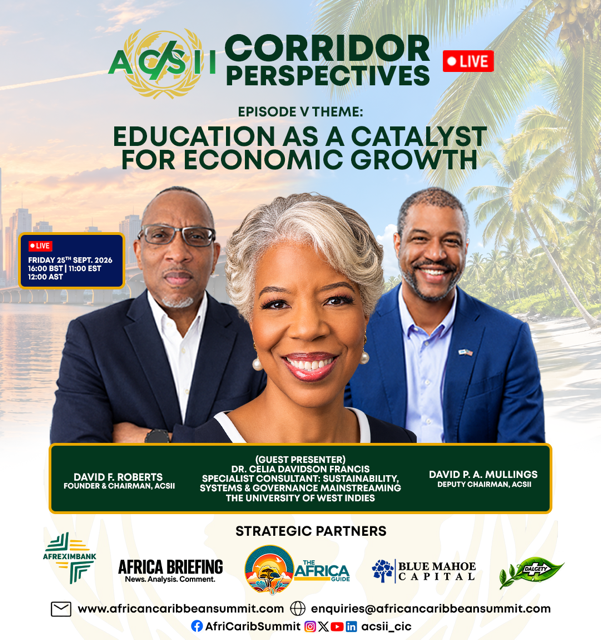
The next episode of Corridor Perspectives – Live will feature Celia Davidson Francis, consultant, focusing on education, skills, governance, sustainability and economic development in Jamaica.