
Why do foreign brands flourish in African markets while so few African businesses achieve similar success abroad? Business consultant Oscar Bimpong believes the answer begins with mindset, but questions about finance and ownership reveal a deeper challenge.
Keypoints:
- Bimpong urges African entrepreneurs to think globally
- Finance and management remain barriers to expansion
- Greater ownership could strengthen economic gains
AFRICAN consumers know international brands well. They eat at foreign restaurant chains, use products manufactured overseas and shop at businesses whose headquarters may be thousands of miles away. Yet relatively few African companies have managed to establish a comparable presence beyond the continent.
Ghanaian business consultant Oscar Bimpong has a simple question.
‘KFC is in Ghana. Why can’t we get JFC of Ghanaian chicken in New York?’
It was one of the more memorable moments of a discussion about Africa–Caribbean trade, but behind the humour lay a serious concern about why African businesses struggle to expand internationally.
Bimpong believes the problem is partly psychological. Too many entrepreneurs, he argues, have become accustomed to operating within familiar boundaries rather than imagining their businesses competing in distant markets.
But ambition alone cannot build a multinational company. Entrepreneurs also need finance, reliable infrastructure, skilled management and access to markets. And even when businesses succeed, there is the larger question of who owns them and benefits from the wealth they create.
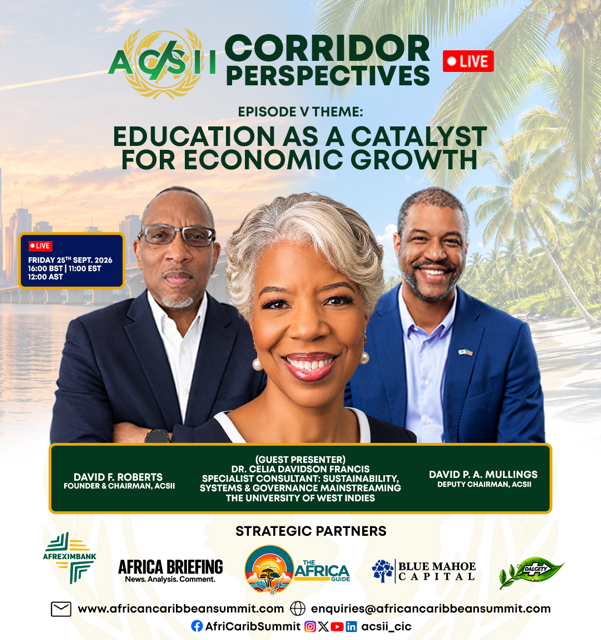
That was the broader issue emerging from the ninth edition of Corridor Perspectives – LIVE, an initiative of the African Caribbean Sustainability & Investment Initiative (ACSII), which promotes closer business and investment relationships between Africa and the Caribbean.
Thinking beyond familiar markets
Bimpong, founder and chief executive of Train2inspire Consultancy, joined David F. Roberts, David Mullings and John Stevenson to examine how attitudes towards entrepreneurship, leadership and collaboration influence business growth.
Drawing on his book, Mindset Revolution: Re-Engineering Your Mind From Prison to Purpose, he argued that people often accept limitations without fully recognising how those beliefs affect their decisions.
‘The most dangerous prison is not the prison with four walls but the prison of the mind,’ he said.
He questioned why Ghanaian companies have a relatively limited international footprint despite operating in a country where foreign businesses have established a substantial presence.
‘How many Ghanaian companies go beyond the corridors of Ghana?’ he asked.
Bimpong believes part of the problem lies in the way Africans sometimes undervalue their own products and expertise.
‘We still believe that anything foreign is better than anything that we produce,’ he said.
The Caribbean participants recognised similar attitudes in their region, where imported products can enjoy greater consumer confidence than locally produced alternatives.
Bimpong traced some of these perceptions to colonial history, arguing that both regions must overcome the belief that commercial success is more readily achieved elsewhere.
There is substance to the concern, although consumer confidence is also shaped by price, quality and reliability. A local product will not succeed simply because people are encouraged to support it. Businesses must earn that confidence and have the resources to deliver consistently.
When entrepreneurs cannot let go
For Bimpong, another obstacle emerges after a business has started making money.
He described entrepreneurs who build successful companies but continue running them as though they were small, one-person operations.
They make every important decision, hesitate to recruit professional managers and sometimes divert earnings into personal purchases rather than reinvesting in the business.
‘We cannot let the business go,’ he said.
As a company grows, so do its responsibilities. More customers mean more employees, suppliers, financial commitments and operational demands. Without stronger management, the founder can become overwhelmed by the very business they worked to establish.
Bimpong argued that entrepreneurs must learn when to delegate responsibilities, bring in expertise and accept investment that allows their companies to expand.
‘You must learn, learn and learn,’ he said.
He also questioned recruitment practices that place too much emphasis on qualifications while overlooking adaptability and willingness to acquire new skills.
‘Skill set is what you are trained to do. Mindset is what you are developed to believe,’ he explained.
His point was not that technical qualifications are unnecessary, but that organisations also need employees and leaders who can respond to change.
For companies seeking to enter international markets, that ability becomes particularly important.
Who owns the wealth?
Yet there is a limit to what changes in individual attitudes can achieve.
Farhia Noor, founder of The African Lens, raised a related question in commentary accompanying the programme: can Africa genuinely transform its economic prospects without changing the structures that determine who owns industries, controls finance and benefits from the continent’s resources?
It is a question that takes the discussion beyond entrepreneurial confidence.
An African entrepreneur may have a strong business idea, understand the market and possess the determination to succeed. But building a factory requires machinery, electricity, reliable suppliers and sufficient working capital to keep production moving.
None of those things can be acquired through confidence alone.
The problem becomes particularly apparent in economies that export agricultural commodities and minerals while importing more expensive finished products.
Greater local processing and manufacturing could help African businesses retain more value, create employment and develop industries with stronger links to domestic economies.
But achieving that requires investment, technical knowledge and infrastructure.
Noor’s challenge does not invalidate Bimpong’s argument. It draws attention to the economic conditions under which entrepreneurial ambition must operate.
A business owner may be prepared to take risks. A bank must still be willing to lend.
Dangote and the financing question
Bimpong acknowledged that reality when the discussion turned to Nigerian industrialist Aliko Dangote.
Asked why Dangote had been able to expand into major industrial ventures, he pointed to the importance of established relationships with financial institutions.
‘Do you know why Dangote is able to do what he’s doing now? Because he had built trust with the banks,’ Bimpong said.
That observation may have been one of the most important of the discussion.
Dangote’s industrial expansion demonstrates the scale of investment African-owned businesses can undertake when commercial ambition is matched by substantial financial resources.
On September 30, 2026, Dangote and Kenyan President William Ruto broke ground on a planned $16bn petroleum refinery in Lamu, Kenya.
The proposed facility is designed to process 700,000 barrels of crude oil daily, although the project remains at an early stage and faces environmental concerns, land disputes and other implementation challenges.
The refinery illustrates the possibilities of African industrial investment, but it also shows how demanding such projects can be.
A smaller entrepreneur may have the same determination to build a manufacturing business without possessing anything approaching Dangote’s access to capital.
That difference matters. Experience, financial credibility and trusted banking relationships can open doors that ambition alone cannot.
Putting money behind the corridor
The debate comes as Africa and the Caribbean seek to build stronger commercial links.
In March 2026, Afreximbank increased its financing ceiling for CARICOM countries to $5bn, up from $3bn.
The bank said more than $750m had already been disbursed, with a further transaction pipeline exceeding $2bn.
The financing is intended to support sectors including infrastructure, agro-processing, healthcare, tourism and financial services.
For businesses on both sides of the Atlantic, such commitments offer the possibility of new investment and trading partnerships.
Yet the obstacles confronting Africa–Caribbean trade extend beyond the availability of money.
Shipping costs remain high, regulatory requirements differ and businesses often lack the networks needed to identify dependable commercial partners.
There is also a more basic problem: not every promising business proposal is ready for investment.
As investment banker Martin Orji argued in an earlier discussion, attracting capital requires credible financial projections, workable commercial structures and the ability to manage risk.
An entrepreneur may identify an attractive opportunity in another country. Converting that opportunity into a functioning business is a different undertaking.
For the Africa–Caribbean corridor, success will depend increasingly on whether institutions can help businesses move from introductions and expressions of interest to completed investments and regular commercial transactions.
Preparing businesses to compete
Bimpong ended his contribution by emphasising the importance of mentoring younger generations.
‘We need to mentor the next generation of Africans and Caribbean,’ he said.
Young people, he argued, already possess considerable ability. What many lack is guidance, access to experienced business leaders and resources to help turn their ideas into viable companies.
Mentorship can provide valuable lessons about managing employees, raising finance and avoiding mistakes that become costly as businesses grow.
But it must be accompanied by practical business education and stronger financial support.
Earlier discussions about the corridor have also highlighted the importance of trust in building Africa–Caribbean commercial partnerships. Entrepreneurs need confidence in one another, while investors need assurances that contracts will be honoured and businesses properly managed.
For Bimpong, changing how people think is an essential part of that process. Noor’s question goes further, asking whether the businesses emerging from these relationships will create greater local ownership and economic opportunity.
The two concerns belong in the same conversation.
Africa and the Caribbean need entrepreneurs prepared to compete internationally. They also need institutions capable of financing their businesses and economic policies that make it easier to produce, trade and invest.
Bimpong’s imaginary Ghanaian chicken restaurant in New York may sound like a modest ambition compared with building an oil refinery.
But opening that restaurant, supplying it reliably, attracting customers and expanding into other cities would demand many of the same business fundamentals: capital, capable management, dependable partnerships and a willingness to take calculated risks.
The mindset to attempt it matters. Having the means to build it, own it and keep it profitable matters just as much.
Next on Corridor Perspectives – LIVE
Episode X, Beyond Media: Building Influence, Intellectual Capital and Institutions for Africa-Caribbean Economic Growth. Guest: Dexter Rose, on Friday, November 06, 2026, at 16:00 GMT | 19:00 EAT | 11:00 EST | 12:00 AST.
Join Corridor Perspectives – LIVE Episode X on YouTube.
For more articles on Africa: The Africa Briefing – https://africabriefing.com/