
Africa and the Caribbean must overcome costly shipping, fragmented regulations and weak financial connections to unlock their commercial potential, trade and compliance specialist Eliot Kelly has warned.
Keypoints:
- Shipping and regulations constrain trade
- Afreximbank raises CARICOM financing to $5bn
- Kelly calls for contracts over conferences
AFRICA and the Caribbean share centuries of history and increasingly ambitious plans for economic cooperation. Yet turning those connections into profitable business remains difficult, with costly shipping, fragmented regulations and limited trade finance standing in the way.
Trade and compliance specialist Eliot Kelly says the two regions must now concentrate on removing those obstacles rather than relying on diplomatic goodwill and declarations of intent.
Our biggest barrier is not geography or history. It is the cost and the complexity of doing business across the Atlantic,’ he said. ‘We must connect our markets physically, financially, and digitally.’
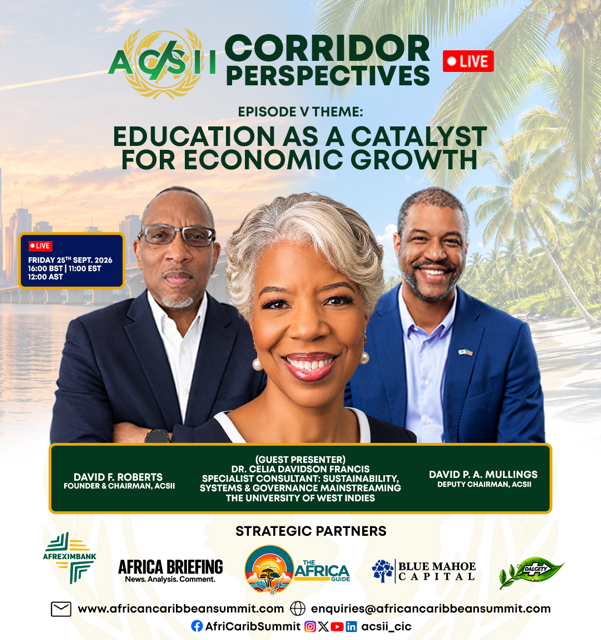
Speaking on Corridor Perspectives – LIVE, presented by the African Caribbean Sustainability & Investment Initiative (ACSII) on October 9, Kelly argued that the next stage of cooperation must focus on making it easier for businesses to find customers, secure financing and complete transactions.
His comments come as financial institutions and regional governments intensify efforts to build stronger commercial connections between Africa and the Caribbean.
AfCFTA creates openings for Caribbean exporters
Kelly believes the African Continental Free Trade Area (AfCFTA) offers Caribbean businesses an opportunity to develop new markets as African economies become more closely integrated.
He identified agro-processing, premium foods, beverages, tourism, education, creative industries and professional services as sectors with promising prospects.
However, he cautioned against assuming that the agreement would immediately eliminate the difficulties facing companies seeking to enter African markets.
‘It’s important to understand that this is a process of integration. It won’t be an overnight transition to completely free trade,’ he said.
The distinction is important. AfCFTA preferential trading arrangements are designed primarily for qualifying trade between participating African countries. Caribbean exporters do not automatically enjoy those preferences simply because they sell into Africa.
As Africa Briefing has examined in its reporting on AfCFTA implementation, differences in customs procedures, rules of origin and national regulations continue to complicate trade even within the continent.
Caribbean companies must therefore identify individual markets, understand local requirements and establish dependable distribution arrangements before committing significant resources.
Trade potential remains largely untapped
The commercial opportunity is considerable, but existing trade flows remain modest.
Research published by the International Trade Centre and Afreximbank in July 2024 estimated bilateral goods trade at $729m, excluding fossil fuels, tobacco and arms. The study suggested annual trade could reach $1.8bn by 2028 if logistics, trade facilitation and value addition improved.
For smaller businesses, however, the barriers often emerge before products leave their countries of origin.
Kelly highlighted expensive transport, inconsistent documentation, differing product standards and difficulties accessing affordable working capital.
These challenges can make otherwise promising transactions commercially unattractive, particularly for entrepreneurs unable to absorb repeated compliance costs or lengthy payment delays.
Kelly believes the priority should be practical outcomes rather than more declarations of intent.
‘Over the next five years I think we need to move from conferences to more contracts,’ he said.
Afreximbank expands Caribbean financing
There are indications that financial institutions are beginning to address some of these constraints.
In March 2026, Afreximbank increased its CARICOM financing limit from $3bn to $5bn, building on more than $750m already disbursed across the region.
The bank also reported a pipeline exceeding $2bn in transactions under execution.
The expanded commitment is intended to support projects including tourism, healthcare, agro-processing and logistics, creating opportunities for deeper economic cooperation.
For Kelly, greater access to capital must be matched by reliable transport links, better commercial information and simpler systems for moving money across borders.
Digital systems could cut compliance costs
Kelly is also developing the Universal Compliance Interoperable Protocol (UCIP), a proposed framework intended to improve communication between existing compliance, documentation and verification systems.
Businesses frequently face repeated identity checks and documentation requirements when operating across different jurisdictions.
UCIP aims to reduce that duplication while preserving regulatory safeguards and data-protection requirements.
‘Our key message is that UCIP is a framework. It’s under development,’ Kelly explained.
He said stakeholder approvals were being pursued, with agribusiness and hospitality being considered for an initial pilot.
The proposal remains at the development stage, and its potential benefits have yet to be demonstrated through independently verified operational results.
Nevertheless, the wider challenge is already attracting institutional attention. Kenya, Nigeria and Morocco have been selected to pilot an AfCFTA-backed digital trade initiative intended to simplify cross-border documentation and information exchange.
Trust must translate into transactions
Beyond finance and technology, Kelly believes stronger business relationships are essential.
He argued that exporters need credible information about prospective partners, dependable commercial networks and opportunities to establish trust across borders.
Kelly said business relationships ultimately depended on whether prospective partners knew, liked and trusted one another.
For him, the underlying problem is not a shortage of ambition or entrepreneurial talent. It is the absence of reliable systems capable of connecting businesses and helping them trade with confidence.
‘Africa and the Caribbean do not lack ambition, talent, or opportunity. What we need is a more effective system for connecting our businesses, aligning our standards, financing our transactions, and moving goods and services across borders,’ he said.
The challenge now is whether governments, financial institutions and businesses can translate those ambitions into functioning trade routes, dependable partnerships and commercial transactions that deliver lasting economic benefits.
Next on Corridor Perspectives – LIVE
Episode VIII, The Future of Global Development Finance. Guest: Inga Carey, on Friday, October 23, 2026, at 16:00 BST | 11:00 EDT.
Join Corridor Perspectives – LIVE Episode VIII on YouTube.
For more articles on Africa: The Africa Briefing – https://africabriefing.com/