
Africa and the Caribbean have no shortage of investment opportunities. What they need are better-prepared projects, stronger financial markets and institutions that give investors the confidence to commit, investment banker Martin Orji argues.
Keypoints:
- Poor project preparation holds back investment
- Blended finance can attract private capital
- Stronger financial links could unlock opportunities
AFRICA and the Caribbean have spent years talking about the enormous investment opportunities that could transform their economies. Yet many promising infrastructure and development projects still struggle to attract the money needed to get them off the ground.
Investment banker Martin Orji believes the problem runs deeper than a shortage of capital. Too many projects reach potential investors without the preparation, financial safeguards or commercial structures needed to secure funding. Until that changes, he argues, ambitious development plans will continue to encounter familiar obstacles.
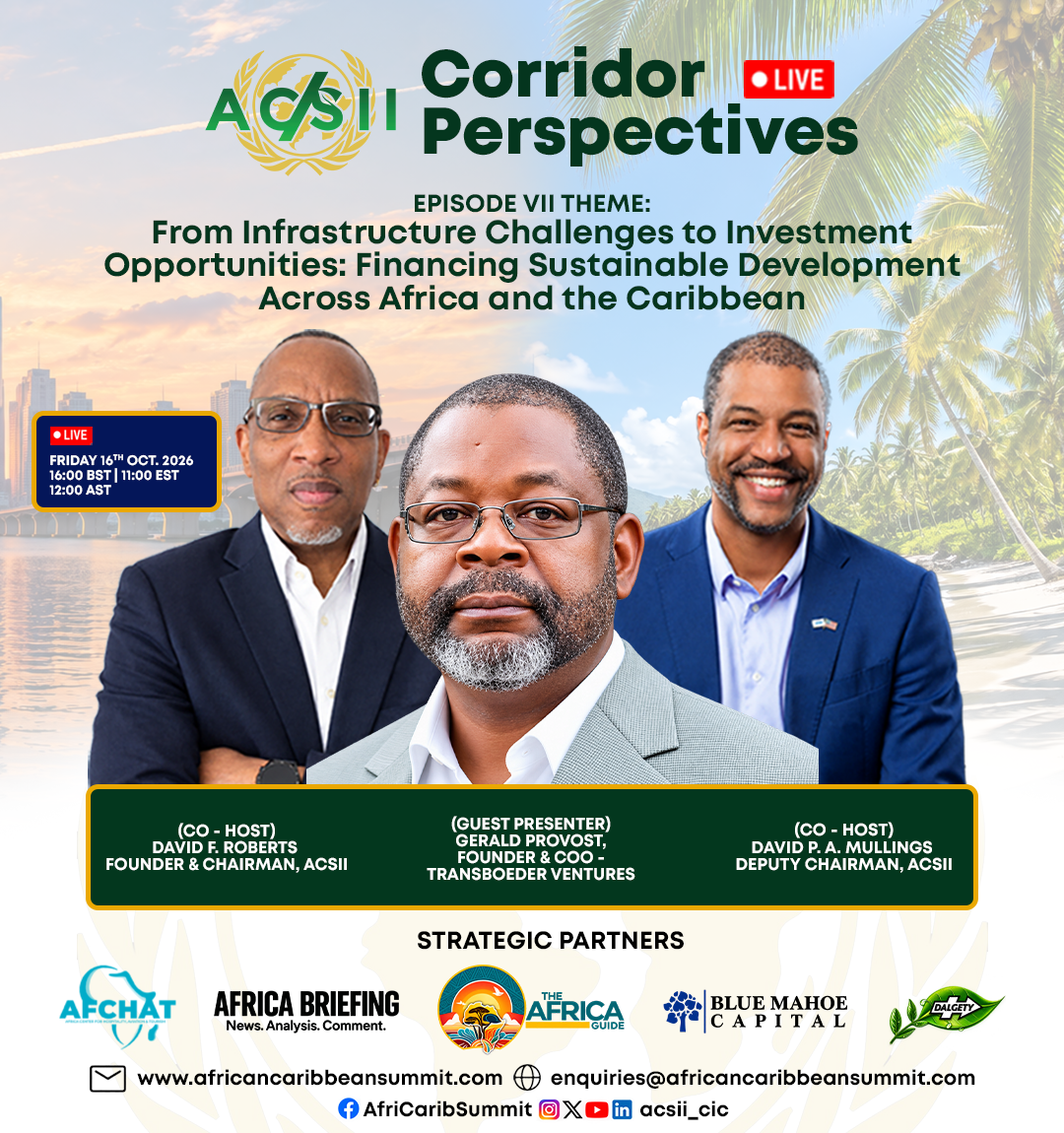
Orji, Managing Partner at Nex Rubica Capital Group, made the case during Episode VIII of Corridor Perspectives – LIVE, hosted by the African Caribbean Sustainability & Investment Initiative (ACSII). Drawing on more than 26 years of experience in investment banking and development finance, he examined what governments, development banks and private investors must do differently.
His central argument was straightforward: having an attractive investment opportunity is one thing. Turning it into a project that banks and institutional investors are willing to finance is quite another.
Why promising projects struggle
Consider a proposed electricity plant, a new port or a food-processing facility. The economic need may be obvious, customers may exist, and governments may be enthusiastic. None of that necessarily convinces a bank to provide financing.
Investors want evidence that the project can be built, operated and paid for without exposing them to unacceptable risks.
‘It’s very, very rare … to have projects that are already bankable off the shelf,’ Orji said.
Before investors commit, they expect credible feasibility studies, experienced technical partners, sound legal arrangements and realistic financial projections.
Even then, what appeals to one investor may not satisfy another.
Orji explained that bankability depends partly on matching a project’s characteristics to the risk appetite of the institution being approached.
This is where many development ambitions begin to unravel. Governments may announce projects long before the essential commercial groundwork has been completed.
The problem is widely recognised. The World Bank’s examination of infrastructure project preparation identifies the shortage of properly prepared public–private partnership projects as a major barrier to private investment.
It also echoes concerns raised in Africa Briefing’s earlier examination of why infrastructure investment needs more than capital.
For Orji, spending money on feasibility studies, transaction advisers and technical assessments is not an unnecessary preliminary expense. It is often what determines whether a project attracts funding at all.
Investors need more than promises
Preparation alone, however, cannot overcome an unpredictable investment environment.
A business considering a 20-year infrastructure commitment must think about more than construction costs and projected revenues.
What happens if tax rules change? Can profits be transferred abroad? Will contracts remain enforceable after a change of government? And what protection exists against sharp currency movements?
These are everyday concerns for investors considering long-term commitments in emerging markets.
‘It’s always going to be about the enabling environment. It’s about the rule of law. It’s about legal framework. It’s about taxation,’ Orji said.
He argued that governments must provide the legal and regulatory confidence needed to attract private capital, while development finance institutions should help pay for the technical preparation that makes projects commercially credible.
The scale of the challenge is considerable.
According to the African Development Bank’s 2026 African Economic Outlook, Africa faces an annual financing shortfall exceeding $1.3tn to achieve the Sustainable Development Goals.
But the bank also identifies weaknesses in domestic revenue mobilisation, financial markets and the effective use of available resources.
In other words, raising more money matters, but making better use of existing financial resources matters too.
Why Africa and the Caribbean should connect
One of Orji’s most interesting arguments concerned the limited financial connections between African and Caribbean markets.
Despite growing political and commercial engagement, investors in either region do not always have straightforward access to opportunities in the other.
Orji questioned why someone investing from Nigeria or South Africa should find it difficult to purchase a financial instrument issued in Jamaica or St Kitts.
‘Why can’t I issue a note in … Jamaica or St Kitts … and have investors in Nigeria and South Africa buy that note?’ he asked.
The challenge is not simply finding willing investors.
Different legal systems, securities regulations, tax arrangements and settlement procedures can complicate cross-border transactions.
Orji wants development institutions to help governments and financial regulators address those barriers, creating conditions in which African and Caribbean investors can more easily finance projects across both regions.
There is already considerable momentum behind closer cooperation.
In March 2026, the African Export-Import Bank (Afreximbank) raised its financing ceiling for the Caribbean Community to $5bn.
The bank reported more than $750m already disbursed and a transaction pipeline exceeding $2bn.
As Africa Briefing reported on Afreximbank’s expanded CARICOM commitment, the funding is intended to support sectors including infrastructure, healthcare, agro-processing and logistics.
Yet financing commitments alone will not remove the obstacles facing businesses.
An earlier Africa Briefing analysis of Africa–Caribbean trade barriers highlighted costly shipping, fragmented regulations and weak financial connections.
These challenges underline Orji’s point: the two regions need practical systems that make investment easier, not merely more agreements promising cooperation.
Bringing different investors together
Orji also sees blended finance as an important way to move projects forward.
The principle is relatively simple. Rather than expecting one bank or investor to finance an entire project, several institutions contribute funding according to their different financial objectives and willingness to take risks.
A development bank might provide long-term financing. A commercial lender could offer another portion, while an export credit agency supplies guarantees and private investors contribute equity.
Together, they can make a project financeable when no single institution would be prepared to carry the full risk.
Orji stressed that the financing structure needs to be considered from the beginning, particularly for large infrastructure projects with long operating lives.
The World Bank’s guidance on blended infrastructure finance similarly explains how development finance and risk-sharing arrangements can encourage commercial investment in projects that private lenders might otherwise avoid.
For governments facing tight budgets, the attraction is clear. Public institutions can help unlock private funding without necessarily financing an entire project themselves.
But the approach is not a guarantee of success. Investors still need reliable revenues, workable contracts and confidence that risks have been fairly allocated.
Who judges Africa’s investment risk?
The interview also explored a sensitive issue in African finance: the influence of international credit rating agencies.
Credit ratings affect how investors assess repayment risks and, ultimately, how much borrowers may have to pay to raise money.
Orji argued that more credible rating agencies and stronger regional oversight could improve the system.
The debate has already produced tensions.
In 2025, the African Union’s African Peer Review Mechanism challenged Fitch Ratings over its assessment of Afreximbank, questioning aspects of the agency’s treatment of the bank’s sovereign lending.
As Africa Briefing reported on the disagreement, Fitch raised concerns about credit risk and loan classification, while the African institution disputed the assessment.
Orji did not suggest that borrowers should escape scrutiny. Rather, he questioned whether the existing oversight arrangements were sufficiently responsive to different financial environments.
For African borrowers, the stakes are considerable. Higher perceived risk can make vital development projects more expensive before construction even begins.
Building the foundations first
Orji was equally cautious about the enthusiasm surrounding sophisticated financial products and digital payment systems.
He acknowledged opportunities in blockchain technology, crypto-assets and alternative payment networks, but warned against introducing complex instruments before markets have the systems and expertise to support them.
‘You can’t go to derivatives if you haven’t figured out normal … trading equities,’ he said.
The message was not that innovation should stop. It was that financial products must solve real problems, whether those involve currency exposure, interest rates, settlement costs or access to investment.
For Africa and the Caribbean, dependable financial infrastructure may deliver more immediate benefits than adopting fashionable technologies without adequate preparation.
Turning ambition into investment
Ultimately, Orji’s argument comes down to execution.
Africa and the Caribbean possess investment opportunities in energy, agriculture, transport, healthcare and climate resilience. The difficulty is turning those opportunities into credible, commercially sustainable projects.
That requires governments to establish predictable rules, development banks to support early project preparation and financial institutions to build stronger connections between markets.
It also means judging progress by completed investments and functioning businesses rather than the size of financing announcements.
The Africa–Caribbean economic corridor has considerable promise. Afreximbank’s growing involvement suggests that financial institutions increasingly recognise its potential.
But recognition is only the beginning.
Unless governments and investors can close the gap between promising ideas and bankable transactions, much of that potential may remain untapped.
For Orji, the lesson is unmistakable: the regions do not simply need more money. They need to become better at making investment work.
Next on Corridor Perspectives – LIVE
Episode IX, The importance of Mindset to trade and investment. Guest: Oscar Bimpong, on Friday, October 30, 2026, at 16:00 GMT | 19:00 EAT | 11:00 EST | 12:00 AST.
Join Corridor Perspectives – LIVE Episode IX on YouTube.
For more articles on Africa: The Africa Briefing – https://africabriefing.com/