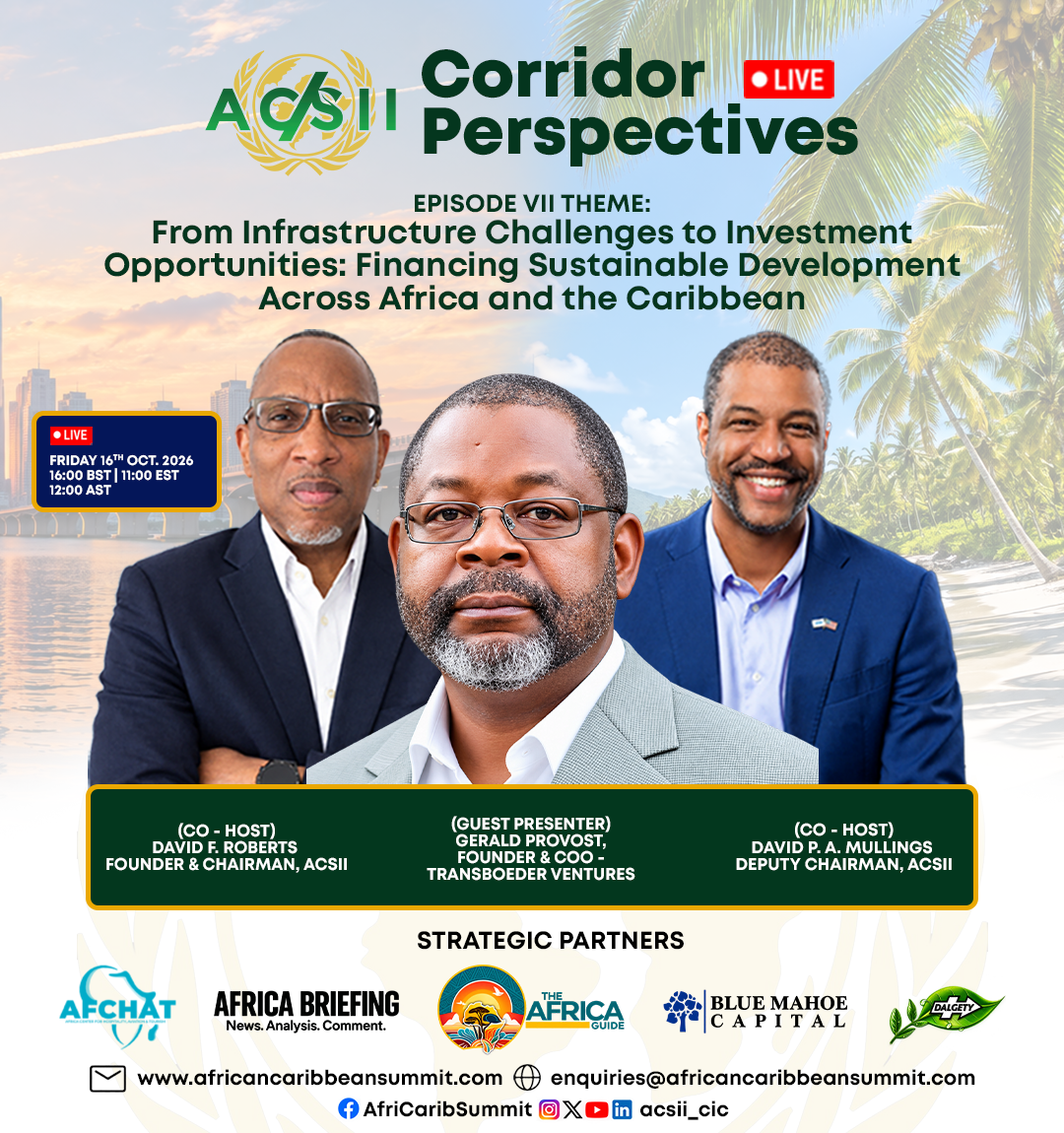
Africa and the Caribbean have enormous infrastructure investment needs, but attracting capital will require better-prepared projects, stronger governance and greater investor confidence, says Transborder Ventures executive Gerald Provost.
Keypoints:
- Investment-ready projects attract capital
- Diaspora expertise goes beyond remittances
- Digital trust strengthens investment prospects
AFRICA and the Caribbean have no shortage of infrastructure projects crying out for investment. What they lack, in many cases, are proposals sufficiently developed to convince investors to put their money behind them, according to Gerald Provost, Founder and Chief Operating Officer of Transborder Ventures.
From unreliable electricity supplies to inadequate transport networks and outdated digital systems, both regions face challenges that could also create opportunities for businesses, investors and local communities. But turning those needs into functioning commercial ventures requires more than recognising the problems.
‘Capital follows confidence,’ Provost said during Episode VII of Corridor Perspectives – LIVE, which examined financing sustainable development across Africa and the Caribbean.
The discussion, hosted by David F. Roberts alongside guest co-host John P. Stevenson, explored why potentially valuable infrastructure projects struggle to attract funding and how governments, investors and diaspora communities could change that.
Investors need more than good ideas
Provost challenged the assumption that a shortage of capital is the main reason infrastructure development struggles to take off.
He argued that many projects fail to reach the financing stage because they remain poorly prepared concepts rather than commercially credible investments.
‘People don’t invest in concepts,’ he said.
For investors, the distinction is crucial.
An electricity project may address an urgent development need, but financiers still want to know how much it will cost, whether customers can pay for the service and how their investment will generate returns.
The same applies to roads, ports, logistics facilities and digital infrastructure.
Without reliable financial projections, effective governance and a convincing implementation strategy, even projects with considerable development potential can struggle to secure backing.
Provost was particularly insistent that investors need projects with ‘clear governance’ and ‘credible returns’, alongside evidence of their wider social benefits.
His assessment reflects concerns raised by the World Bank about weaknesses in infrastructure project preparation.
For African governments already grappling with heavy financing demands, the ability to prepare credible projects could make the difference between attracting long-term investment and watching development plans remain on paper.
Diaspora must become investment partners
The discussion also turned to the economic potential of Africans and Caribbean nationals living overseas.
Provost argued that governments have traditionally approached diaspora communities primarily as sources of remittances, overlooking their wider contribution to national development.
He described diaspora populations as ‘underutilized assets’, pointing to the professional experience, international connections and commercial opportunities they can bring.
The argument goes beyond encouraging people abroad to send more money home.
A diaspora engineer could help develop an energy project. A financial professional might connect local businesses with international investors. An entrepreneur operating overseas could open markets for products that would otherwise struggle to find customers.
Provost urged governments to explore investment structures that bring together public finance, private capital and diaspora participation.
That approach reflects a wider debate about building trust in diaspora investment.
But participation must be supported by credible safeguards. Emotional ties to home countries may encourage initial interest, yet investors still need transparent institutions and confidence that their money will be managed responsibly.
Infrastructure gaps can create industries
For Provost, infrastructure shortages should not automatically be treated as obstacles to growth.
He argued that they also reveal where demand exists and where investment could produce commercially useful assets.
Unreliable electricity supplies create opportunities for renewable energy and distribution projects. Poor transport connections point towards investment in logistics. Waste management challenges can support recycling and energy-recovery industries.
However, he warned against viewing these developments as isolated investments.
‘One has to start thinking in terms of ecosystems rather than promoting isolated projects,’ he said.
A modern port, for example, depends on reliable roads, electricity, payment systems and businesses capable of moving goods through it.
Without those connections, even expensive infrastructure can fail to deliver its full economic benefits.
This is particularly relevant to Africa–Caribbean commerce, where shipping costs and limited trade connections remain significant barriers.
The wider opportunity, Provost suggested, is to create commercial environments where different investments support one another and encourage further business activity.
Digital technology needs public trust
Digital transformation emerged as another important part of the investment equation.
Provost argued that connected payment systems, reliable commercial data and interoperable digital platforms could make it easier for businesses and investors to operate across borders.
The objective, as he described it, was to turn ‘information into trust’, and ultimately trust into investment.
But Stevenson questioned whether governments and financial institutions were adequately prepared for the cybersecurity risks accompanying greater digital connectivity.
He pointed to vulnerabilities affecting banking systems in the Caribbean, warning that new technologies could introduce additional risks if basic safeguards were neglected.
The discussion highlighted a wider challenge for developing economies. Technology may make business transactions faster and cheaper, but investor confidence also depends on effective regulation, secure systems and institutions capable of protecting sensitive information.
AI must improve people’s lives
The conversation eventually turned to artificial intelligence, particularly the growing demand for data centres and the implications for developing economies.
Provost sees opportunities for AI to make public services more accessible, improve business efficiency and give communities better access to information.
However, Stevenson challenged the assumption that technological progress would automatically benefit everyone.
He raised concerns about unequal access to digital tools, differences in education and the environmental costs associated with expanding data centres.
Provost acknowledged that not everyone would embrace new technologies at the same pace, but argued that public acceptance would grow when people understood the practical benefits.
For him, the most important question was: ‘How does it change people’s lives?’
That question goes beyond AI.
Whether governments are investing in electricity, transport networks, digital payments or public services, infrastructure projects ultimately need to demonstrate how they will improve economic opportunities and living conditions.
Turning opportunities into investment
For the African Caribbean Sustainability & Investment Initiative (ACSII), the discussion highlighted the importance of connecting governments, investors and businesses around projects that can move beyond proposals to actual implementation.
Provost identified three priorities: preparing genuinely investment-ready projects, bringing together public and private finance with diaspora participation, and developing connected digital systems to support trade and investment.
The conversation did not announce new financing agreements or investment commitments. Instead, it offered a practical framework for addressing the persistent gap between development ambitions and projects capable of securing funding.
For governments, that means strengthening institutions, improving project preparation and creating predictable conditions for investors.
For businesses, it means showing that commercial opportunities can generate credible financial returns while meeting genuine development needs.
And for diaspora communities, it means having access to transparent investment opportunities that offer more than an emotional connection to their countries of origin.
Africa and the Caribbean already know where many of their infrastructure problems lie. They do not need another reminder that electricity networks, transport systems and digital services require investment.
What they need are projects that can withstand financial scrutiny and partnerships capable of delivering them.
Provost’s argument ultimately comes down to a straightforward proposition: the investment opportunity exists, but confidence must be earned.
Next on Corridor Perspectives – LIVE
Episode VIII, The Future of Global Development Finance. Guest: Inga Carey, on Friday, October 23, 2026, at 16:00 BST | 11:00 EDT.
Join Corridor Perspectives – LIVE Episode VIII on YouTube.
For more articles on Africa: The Africa Briefing – https://africabriefing.com/