
Zambia’s search for investment has brought it into an emerging Africa–Caribbean trade initiative, offering fresh possibilities for industrial development even as electricity shortages, financing constraints and costly transport threaten progress, reports Jon Offei-Ansah
Keypoints:
- Zambia seeks investment beyond traditional partners
- Africa–Caribbean trade potential could reach $1.65bn
- Infrastructure and financing remain serious obstacles
ZAMBIA is widening its search for foreign investment, looking to new business partners as it tries to build industries around its mineral wealth and reduce an economic dependence on copper that has persisted for decades.
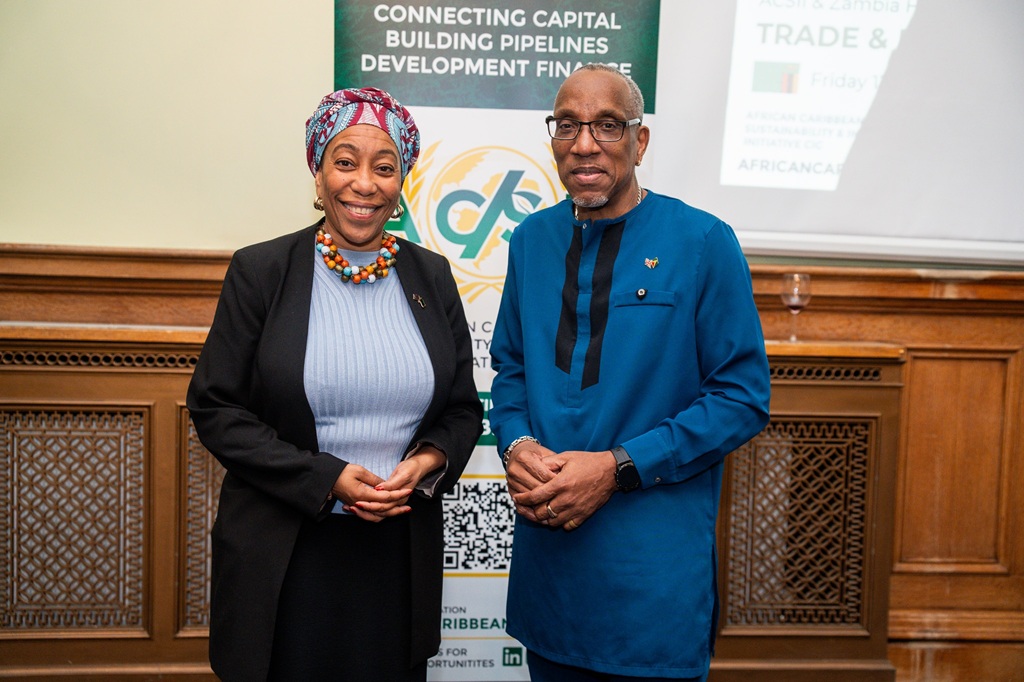
The country’s ambitions took centre stage at Zambia House in London on November 13, where diplomats, investors and business leaders gathered for the ACSII Zambia Trade and Investment Soirée. Organised by the African Caribbean Sustainability & Investment Initiative (ACSII) in partnership with the Zambian High Commission, the event sought to connect Zambia’s investment priorities with a broader effort to encourage trade between Africa and the Caribbean.
For Zambia, the attraction is access to new investors, markets and business expertise. The Caribbean initiative, meanwhile, is seeking to give commercial substance to a relationship that has long been sustained more by shared history and diplomacy than by trade. How much either side gains will depend on whether businesses can find viable projects and overcome the financial and logistical barriers separating the two regions.
Zambia looks beyond copper
Zambia’s High Commissioner to the United Kingdom, Macenje Mazoka, told the gathering that the government’s Grow Zambia Agenda was designed to encourage investment in productive industries and create jobs.
‘It’s about moving beyond simply exporting raw materials towards value addition, industrialisation, job creation, and sustainable growth,’ she said.
Mazoka identified agriculture, agro-processing, mining, critical minerals, renewable energy, tourism, manufacturing, infrastructure and the digital economy as priorities.
Her message comes at a time when Zambia is trying to take greater advantage of international demand for copper, a metal essential to electricity networks, renewable energy systems and electric vehicles.
The country has substantial mineral resources, but much of its export income still comes from copper. Expanding production offers opportunities for growth, although the benefits depend partly on how much processing, manufacturing and other economic activity can be developed locally.
That has proved difficult. Producing more copper does not necessarily mean creating enough jobs or building the industries needed to support a growing population.
Successive governments have sought to encourage mineral processing and attract manufacturers that can supply the mining industry. Progress has been uneven, held back by infrastructure problems, high financing costs and uncertainty over investment conditions.
Electricity is an especially pressing concern.
The drought that struck Southern Africa in 2024 severely affected Zambia’s hydropower generation, causing shortages that disrupted businesses and households. Manufacturers faced higher costs, while mining companies had to manage interruptions to electricity supplies.
Although conditions have improved, energy remains a constraint on growth. In May, the IMF lowered its projection for Zambia’s economic expansion in 2026 to 4.3 percent, citing weaker mining output, energy constraints and other pressures.
Plans to strengthen electricity supplies are moving forward, but progress takes time. The Zambia–Tanzania power interconnector is now expected to enter service in 2029, a year later than previously anticipated.
These difficulties matter to prospective investors. Building a processing plant or manufacturing facility requires more than access to raw materials. Electricity must be reliable, transport affordable and production costs competitive.
Zambia’s efforts to attract capital into renewable energy and infrastructure are therefore closely connected to its wider industrial plans.
Why the Caribbean matters
The London gathering introduced another dimension to Zambia’s investment campaign.
Africa and the Caribbean have deep historical and cultural ties, but trade between them remains small compared with their commercial relationships with Europe, North America and Asia.
ACSII wants to bring businesses on both sides of the Atlantic into closer contact.
Its chairman, David F Roberts, told participants that the two regions should be seen as capable economic partners rather than mainly as recipients of international development assistance.
‘Africa and the Caribbean should not be viewed primarily as recipients of development assistance, but as partners, markets, and leaders in innovation, sustainability, and economic development,’ he said.
The organisation is developing a proposed trade and investment corridor, supported by a membership network, training programmes through the ACSII Academy and discussions under its Corridor Perspectives platform.
The aim is to help businesses identify partners, understand unfamiliar markets and find opportunities that might otherwise go unnoticed.
There are areas where the approach could work.
Caribbean businesses have experience in tourism, financial services, agriculture and specialised manufacturing. Zambia offers opportunities in some of the same industries, particularly where investment could support food processing, hospitality, technology and business services.
But the Caribbean is unlikely to become a major source of finance for Zambia’s largest mining projects. Those developments require substantial capital and will continue to depend heavily on multinational companies, international lenders and development finance institutions.
Smaller ventures may offer more immediate prospects. A food-processing company, tourism business or specialist service provider could find opportunities through partnerships that do not require the enormous financing associated with major mining and infrastructure projects.
Even so, companies must be able to find reliable counterparts and establish trust.
An earlier Africa Briefing examination of the obstacles facing Africa–Caribbean business relationships identified confidence, financing and weak commercial connections among the problems holding back trade.
Those difficulties cannot be resolved by diplomacy alone.
How realistic is the $1.65bn opportunity?
New research provides a clearer indication of the trade opportunities available.
A report published on November 3 by the International Trade Centre and Afreximbank estimates that annual trade in goods and services between Africa and the Caribbean could reach $1.65bn by 2030, excluding mineral fuels.
The study, Reshaping Africa-Caribbean Trade: Opportunities for Economic Transformation, found that around 80 percent of Africa’s estimated annual goods export potential to the Caribbean remains untapped.
It identified possibilities in processed foods, chemicals, textiles, minerals, tourism, transport and creative industries.
The findings suggest that businesses have considerable room to expand trade. They also show how far the two regions remain from exploiting that potential.
Shipping is expensive, direct transport connections are limited and companies often lack reliable information about customers and suppliers in each other’s markets.
For Zambia, geography makes the problem harder.
As a landlocked country, it must move most of its overseas exports through neighbouring countries to reach seaports. Sending products onwards to Caribbean markets adds further costs.
Some goods may struggle to compete with supplies from countries closer to the Caribbean. Higher-value products and services could offer better prospects, although businesses would still need to establish sufficient demand.
The $1.65bn projection is therefore best understood as an indication of what improved trading conditions might deliver, not a measure of business already secured.
Money alone will not close the gap
Afreximbank has sought to encourage stronger commercial links by increasing its financing commitment to Caribbean economies to $5bn.
The funding framework covers infrastructure, industrial development, trade and other economic activities, giving businesses access to financial support that has historically been limited.
The bank’s expanded commitment to Caribbean development is an important part of efforts to build stronger links with African markets.
Yet financing commitments do not automatically translate into investments.
Banks and other investors need projects with credible business plans, realistic financial projections and clear arrangements for managing risks.
This was among the concerns raised by investment banker Martin Orji in an earlier ACSII Corridor Perspectives discussion. As explored in his assessment of the Africa–Caribbean investment gap, weaknesses in project preparation and financial structures can prevent businesses from attracting funding even when investors have money available.
Zambia faces similar problems.
Renewable energy projects need dependable customers and workable electricity tariffs. Manufacturers must demonstrate that their products can compete. Agricultural processors need reliable supplies, adequate storage and access to markets.
Investors will also examine currency risks, taxation and the consistency of government policy.
These are practical commercial questions, not matters that can be settled through expressions of diplomatic support.
Turning contacts into business
The London event gave Zambia an audience for its investment plans and allowed ACSII to introduce prospective partners to its wider trade initiative.
Participants welcomed the effort to connect African and Caribbean businesses, while Roberts emphasised the need to move beyond receptions and networking.
Some business contacts may develop into partnerships; others may not progress beyond preliminary discussions.
What Zambia needs is investment that helps expand production, improve infrastructure and create employment. The country’s mineral wealth gives it an advantage, but investors will also want evidence that industrial projects can operate profitably.
The proposed Africa–Caribbean corridor could become a useful additional route for investment, particularly for smaller businesses and specialist ventures seeking new markets.
Its prospects will depend on the less visible work that follows gatherings such as the one in London: preparing projects, arranging finance, negotiating contracts and finding customers.
Roberts summed up the ambition when he told participants: ‘History has connected Africa and the Caribbean. It is now our responsibility to make economics, investment, and shared prosperity the next chapter of that relationship.’
The economic case for closer ties deserves attention. For Zambia, however, the more pressing task is to turn the interest generated abroad into businesses capable of producing, employing and exporting at home.
For more articles on Africa: The Africa Briefing – https://africabriefing.com/