By David F. Roberts MSc Founder and Chairman, African Caribbean Sustainability and Investment Initiative (ACSII)
The world is entering a period of profound geopolitical and economic realignment. Supply chains are being redesigned, global investment flows are shifting, and strategic competition between major powers is reshaping trade relationships. Climate change, sovereign debt, food insecurity, technological disruption and regional conflicts continue to test the resilience of developing economies.
For Africa and the Caribbean, these challenges present a stark choice: remain peripheral participants in a rapidly changing global economy, or build a stronger, more coordinated South–South partnership capable of creating shared prosperity.
At the African Caribbean Sustainability and Investment Initiative (ACSII), we believe the answer is clear. The Africa–Caribbean partnership matters now more than at any time in our shared history.
From Shared History to Shared Prosperity
The relationship between Africa and the Caribbean has often been viewed through the lens of history, culture and identity. These bonds remain deeply important, but they are no longer enough. The next chapter must be written in the language of investment, trade, entrepreneurship, innovation and sustainable development.
Collectively, Africa and the Caribbean represent more than 1.5 billion people, abundant natural resources, some of the world’s fastest-growing markets, expanding digital economies, and an increasingly educated and entrepreneurial young population. Yet direct trade between our regions remains remarkably low, and investment opportunities frequently pass through third-party markets before reaching their intended destinations.
This represents one of the greatest untapped economic opportunities of the twenty-first century.
Building Institutions That Bridge Continents
Strong economic partnerships are never built by chance. They require institutions, trusted relationships and long-term commitment.
ACSII has focused on developing practical platforms that connect governments, investors, development finance institutions, private sector leaders and entrepreneurs. We are grateful to the organisations that have recognised this vision and supported our journey.
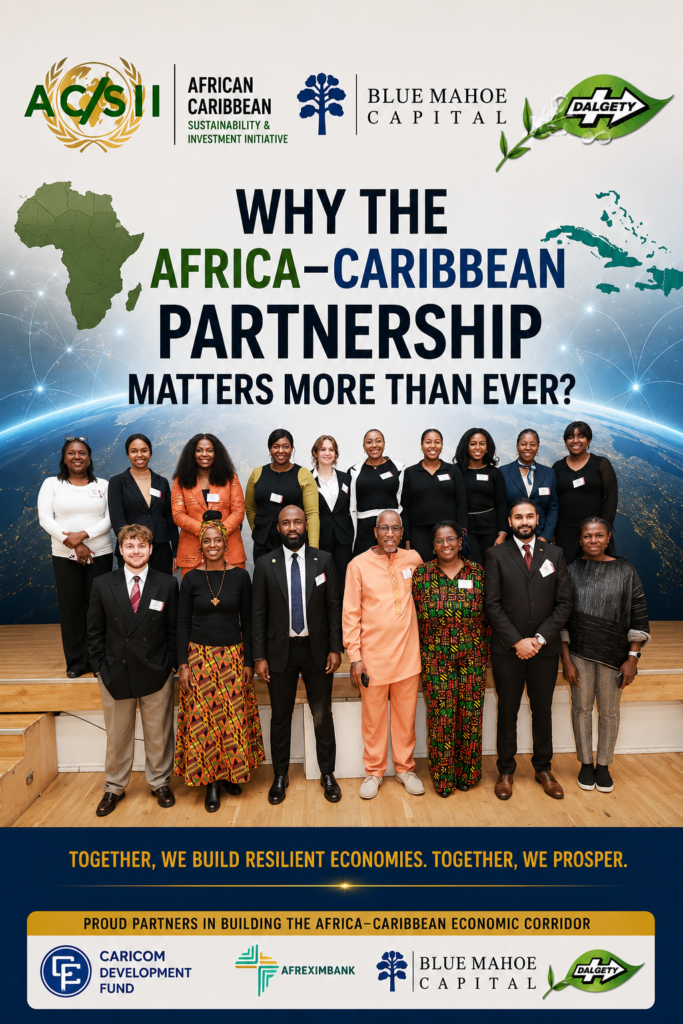
The CARICOM Development Fund (CDF) and Afreximbank, whose support for the African Caribbean Sustainability and Investment Summit (ACSIS) demonstrated confidence in the importance of closer Africa–Caribbean cooperation, have helped validate the need for stronger economic dialogue between our regions.
Our strategic partnership with Blue Mahoe Capital represents another important milestone. As an organisation committed to unlocking investment opportunities across the Global South, Blue Mahoe Capital brings valuable expertise, international networks and investment experience that complement ACSII’s mission of building sustainable economic corridors.
Partnerships such as these demonstrate that collaboration, not competition, will define successful South–South development.
Turning Vision into Practical Action
Ideas alone do not transform economies; projects do. That is why ACSII has begun building practical initiatives designed to increase commercial engagement between Africa and the Caribbean.
The proposed Nigeria–CARICOM Trade Corridor seeks to establish structured commercial relationships between Nigeria, Africa’s largest economy, and the CARICOM region. The objective is not simply to increase exports and imports, but to facilitate investment partnerships, joint ventures, technology transfer and institutional cooperation that generate lasting economic value.
The Barbados Trade Bridge Mission has been developed to connect businesses, investors and public sector leaders through carefully curated commercial engagement. Barbados offers an ideal gateway into CARICOM markets while strengthening relationships with African enterprises seeking regional expansion.
Knowledge sharing remains equally important. The forthcoming ACSII Trade and Investment Webinar Series will provide a platform where policymakers, investors, entrepreneurs and development practitioners can exchange ideas, explore opportunities and discuss practical solutions to common economic challenges.
Alongside this, the planned ACSII Trade Academy will equip entrepreneurs, exporters, government officials and business leaders with the knowledge required to participate successfully in international trade, investment promotion, project preparation and cross-border commercial partnerships.
Each initiative addresses a different component of the same objective: creating stronger institutional links between Africa and the Caribbean.
A Changing Global Environment
Today’s international environment reinforces the urgency of this work.
Persistent conflicts in Europe and the Middle East continue to affect global energy markets and food prices. Rising protectionism and industrial policy in major economies are altering global trade patterns. High debt burdens continue to constrain many developing nations, while climate change increasingly threatens tourism, agriculture, coastal infrastructure and energy security throughout both Africa and the Caribbean.
At the same time, rapid advances in artificial intelligence, digital finance and advanced manufacturing risk widening the technological gap between developed and developing economies if appropriate investments are not made today.
These challenges are real, but they also create opportunities. As traditional trading relationships become less predictable, governments and businesses are increasingly seeking reliable partners with shared interests and complementary strengths. Africa and the Caribbean possess exactly that combination.
The South–South Opportunity
South–South cooperation has moved beyond diplomatic aspiration; it is becoming an economic necessity.
Africa brings scale, manufacturing potential, expanding consumer markets, critical minerals, agricultural capacity and one of the world’s youngest populations. The Caribbean contributes globally respected financial services, logistics expertise, tourism excellence, creative industries, educational institutions, maritime experience and strategic geographic positioning between North and South America.
Together, these complementary strengths can generate entirely new value chains: African agricultural producers partnering with Caribbean food processing companies; Caribbean financial institutions supporting infrastructure investment across African markets; joint ventures in renewable energy, digital innovation, healthcare, creative industries, maritime logistics and sustainable tourism.
These are not distant possibilities. They are practical opportunities awaiting coordinated leadership.
Leadership Through Partnership
No single organisation can build an Africa–Caribbean economic corridor alone. Success will require governments, development finance institutions, chambers of commerce, universities, investors, entrepreneurs, philanthropists and civil society working together with a common purpose.
ACSII is committed to serving as a trusted convenor that brings these stakeholders together, encourages meaningful dialogue and helps transform promising conversations into measurable outcomes. Every partnership we establish contributes another building block towards a more integrated Africa–Caribbean economic future.
Looking Ahead
The future will not belong solely to the world’s largest economies. It will increasingly favour those regions capable of building trusted partnerships, mobilising investment, sharing knowledge and creating resilient economic networks.
Africa and the Caribbean have waited long enough to unlock their collective potential. The opportunity before us is extraordinary, and the responsibility to seize it belongs to all of us.
As Chairman of ACSII, I remain optimistic that through vision, partnership and sustained commitment, we can help shape a new era of Africa–Caribbean cooperation, one defined not simply by our shared past, but by our shared prosperity.
The corridor is open. Now we must build it, together.