Africa and Caribbean entrepreneurs will not build globally competitive companies on finance alone. They need markets, knowledge, institutions and commercial networks capable of turning ambition into lasting enterprise, writes David F. Roberts. Published on: The Africa Briefing
THERE is a persistent assumption in development and entrepreneurship circles that putting more money into the hands of entrepreneurs will automatically produce stronger businesses, more jobs and more prosperous economies.
Capital matters. But capital alone is not an ecosystem.
An entrepreneur can receive funding and still fail because they cannot reach the right market, find reliable suppliers, navigate regulation, understand export requirements, recruit skilled people, secure appropriate technology, obtain affordable insurance or connect with investors able to support the next stage of growth.
For Africa and the Caribbean, this distinction matters enormously.
If we are serious about creating a sustainable Africa–Caribbean economic corridor, we must move beyond a development model centred overwhelmingly on financing individual businesses. We also need the relationships, knowledge, institutions and market infrastructure that allow those businesses to survive, compete and grow.
That principle increasingly shapes the work of the African Caribbean Sustainability & Investment Initiative, or ACSII.
The real problem comes after funding
Ask an entrepreneur what they need and the first answer will often be finance.
Then ask a more difficult question: what happens after the money arrives?
Where will the business sell its products? Who are its customers? Can it export? Who can distribute its goods? Which regulations apply? Can it access foreign exchange? Does the management team have the capacity to scale? Can the company protect its intellectual property? Who can help it enter another market?
These are ecosystem questions.
And in many cases, they become more important than the initial cheque.
A Nigerian entrepreneur seeking to enter Barbados, for example, does not simply require working capital. The business may need market intelligence, regulatory guidance, logistics support, distribution partners, local credibility and introductions to Caribbean investors or strategic partners.
A Caribbean entrepreneur trying to expand into Nigeria faces the same challenge in reverse.
What both need is a bridge.
Uncertainty makes stronger links essential
The case for building these bridges is becoming more urgent as the global economic environment grows more unpredictable.
Geopolitical tensions, protectionism, supply-chain disruption, climate pressures, heavy debt burdens and fierce competition for investment are increasing the vulnerability of developing economies.
African and Caribbean countries face these pressures in different ways.
Small island economies must contend with significant climate and infrastructure challenges, while many African economies continue to face financing gaps, infrastructure constraints and the pressing need to create productive employment for expanding populations
At the same time, technological disruption, including artificial intelligence, is reshaping the competitive landscape.
The danger is that our economies remain primarily markets for other people’s products, technology and capital rather than becoming stronger producers, investors and owners of intellectual property.
That is not an outcome we should accept.
The answer is not economic isolation. It is better connectivity, deeper commercial relationships and more effective South–South cooperation.
Building the ecosystem around enterprise
That is why an effective Africa–Caribbean enterprise strategy must extend beyond connecting businesses with financiers.
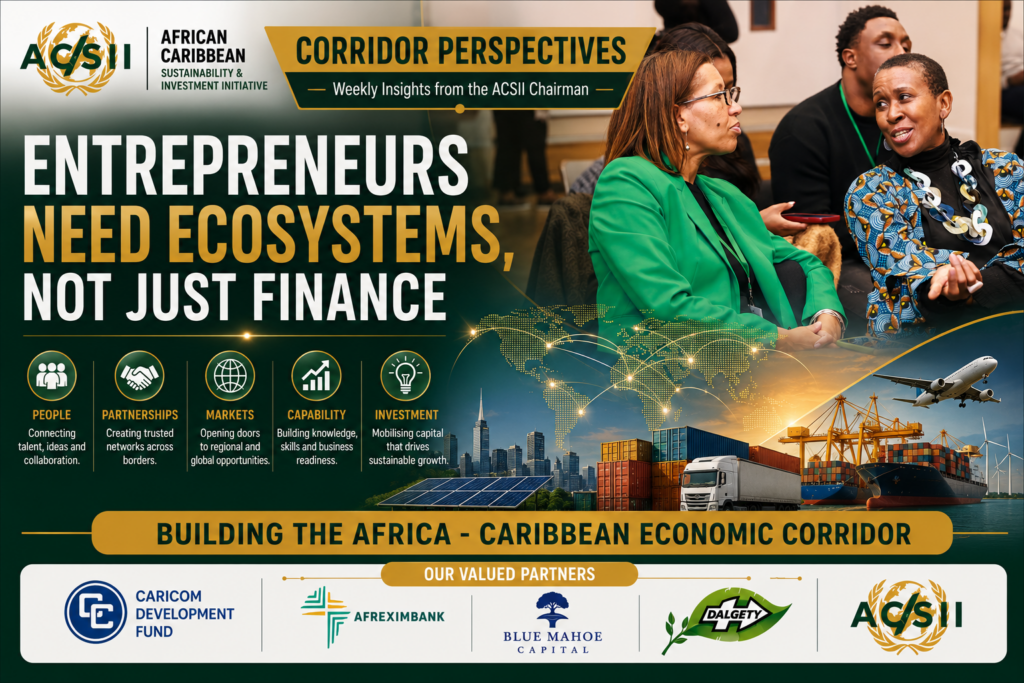
Entrepreneurs need a pathway from idea to capability, from capability to market, from market to investment and ultimately from investment to scale.
That requires interconnected platforms rather than isolated interventions.
The proposed ACSII Nigeria–CARICOM Trade Corridor is one attempt to create such a framework.
Nigeria and the wider CARICOM region possess complementary economic strengths. Nigeria brings enormous market scale, entrepreneurial energy, technological capability, agricultural and manufacturing potential and access to opportunities across the African continent.
The Caribbean brings access to the Americas, sophisticated financial and professional services, tourism expertise, creative industries, maritime capabilities and valuable international networks.
But complementary strengths do not automatically become commercial relationships.
Someone has to create the connections.
Trade missions must produce business
The planned ACSII Barbados Trade Bridge Mission illustrates what this approach should mean in practice.
A trade mission cannot simply be an overseas visit, a collection of speeches or another networking event where participants exchange business cards and return home.
The objective must be commercial outcomes.
Entrepreneurs should meet prospective customers, investors, government representatives, business leaders and strategic partners with a clear pathway towards joint ventures, investment, market entry, technology partnerships, exports and long-term collaboration.
That is what a genuine trade bridge should deliver.
For African companies, Barbados can provide an entry point into Caribbean markets and potentially wider markets in the Americas. For Caribbean businesses, engagement with Africa offers access to scale that smaller domestic economies cannot easily provide.
The value lies not in the journey itself, but in what happens after the introductions are made.
Institutions must share the burden
Entrepreneurs cannot build international trade corridors alone.
Development finance institutions, governments, investors, universities, professional advisers and private-sector organisations all have roles to play in creating an environment in which enterprise can flourish.
ACSII’s own experience has reinforced that lesson.
The CARICOM Development Fund and Afreximbank supported ACSIS 2025, while ACSII’s 2026 strategic partnership with Blue Mahoe Capital brings private investment expertise into the emerging network.
The broader principle matters more than any individual organisation.
Effective enterprise ecosystems require government, development finance, private capital, entrepreneurs, knowledge institutions and markets to work together.
That combination is considerably more powerful than finance operating in isolation.
Knowledge can be as valuable as capital
One of the biggest barriers to international expansion is not always a lack of ambition or money.
It is lack of knowledge.
A successful entrepreneur may understand a domestic market extremely well while knowing very little about another country’s customs procedures, international contracting, export finance, intellectual property rules, taxation or cross-border due diligence.
That knowledge gap can make an otherwise promising business unprepared for international expansion.
This is why platforms such as the ACSII Trade and Investment Webinar Series and the proposed Trade Academy form part of the wider ecosystem approach.
The purpose should be practical: to bring policymakers, investors, development finance institutions, specialists and entrepreneurs into the same conversation and give businesses the skills they need to participate credibly in international commerce.
Trade readiness itself is an investment asset.
An entrepreneur who understands how to enter and operate in a foreign market is considerably more investable than one who merely has a good product and ambition.
South–South cooperation can change the equation
The opportunity extends far beyond trade missions or individual investment deals.
Africa and the Caribbean should not regard themselves only as destinations for capital originating elsewhere.
We should increasingly see one another as sources of capital, customers, partners, knowledge, technology and investment opportunities.
Imagine African manufacturers working with Caribbean distributors.
Imagine Caribbean financial expertise supporting African infrastructure development, African agricultural enterprises partnering with Caribbean food processors, or African fintech companies collaborating with Caribbean financial institutions.
Tourism operators, universities, technology businesses, creative companies and training institutions could form similar partnerships.
Most importantly, entrepreneurs from both regions could build companies together.
That is where South–South cooperation becomes more than a diplomatic phrase.
It creates economic relationships and, over time, economic interdependence.
We need owners, not only entrepreneurs
There is another dimension to this debate that deserves greater attention.
For generations, much of the development conversation has focused on creating entrepreneurs. But entrepreneurship without ownership of valuable assets can still leave communities economically vulnerable.
We need entrepreneurs who build scalable companies.
We need businesses that own intellectual property, brands, technology, distribution networks and productive assets.
We need African and Caribbean companies capable of becoming regional and international players.
We need African and Caribbean investors putting capital into African and Caribbean enterprises.
And we need today’s successful entrepreneurs to become tomorrow’s investors.
That is how a functioning ecosystem becomes self-reinforcing.
The entrepreneur of today should be able to become the investor, mentor and institution-builder of tomorrow.
A corridor must work for ordinary businesses
An Africa–Caribbean economic corridor cannot exist only in government agreements, conference communiqués and trade missions.
It must eventually become something ordinary businesses can use.
A Jamaican entrepreneur should be able to identify and enter an African market. A Nigerian manufacturer should be able to find a credible Caribbean distributor. A Barbadian investor should be able to assess an African infrastructure opportunity. A Ghanaian technology company should be able to collaborate with a Caribbean financial services business.
Entrepreneurs should know where to find capital, knowledge, partners, markets and professional support.
That is when the idea of an economic corridor becomes real.
The opportunity is ours to organise
The global economy is being reorganised around new alliances, technologies, supply chains and centres of influence.
Africa and the Caribbean cannot control every geopolitical tension, interest-rate decision, climate shock or policy adopted by the world’s major economic powers.
But we can determine how effectively we organise ourselves.
Our regions possess complementary strengths. The challenge is connecting them in ways that create lasting commercial value.
That means building institutions and platforms that help entrepreneurs meet investors, investors identify credible projects, governments remove barriers and businesses enter unfamiliar markets with greater confidence.
Finance remains essential.
But finance without an ecosystem can become a short-term intervention. An effective ecosystem creates the possibility of sustainable growth.
Initiatives such as the Nigeria–CARICOM Trade Corridor, Barbados Trade Bridge Mission, Trade and Investment Webinar Series and Trade Academy should ultimately be judged by that standard: whether they turn relationships into commerce, commerce into investment and investment into sustainable enterprise.
The future of Africa–Caribbean economic cooperation will not be determined simply by how much capital our regions can attract.
It will depend on how effectively we connect capital with people, people with markets, markets with knowledge and knowledge with opportunity.
Entrepreneurs do not just need finance.
They need somewhere for their ambition to go.
 David F. Roberts MSc is Founder and Chairman of the African Caribbean Sustainability & Investment Initiative. Corridor Perspectives is his thought-leadership column examining the opportunities and challenges shaping the emerging Africa–Caribbean economic corridor.