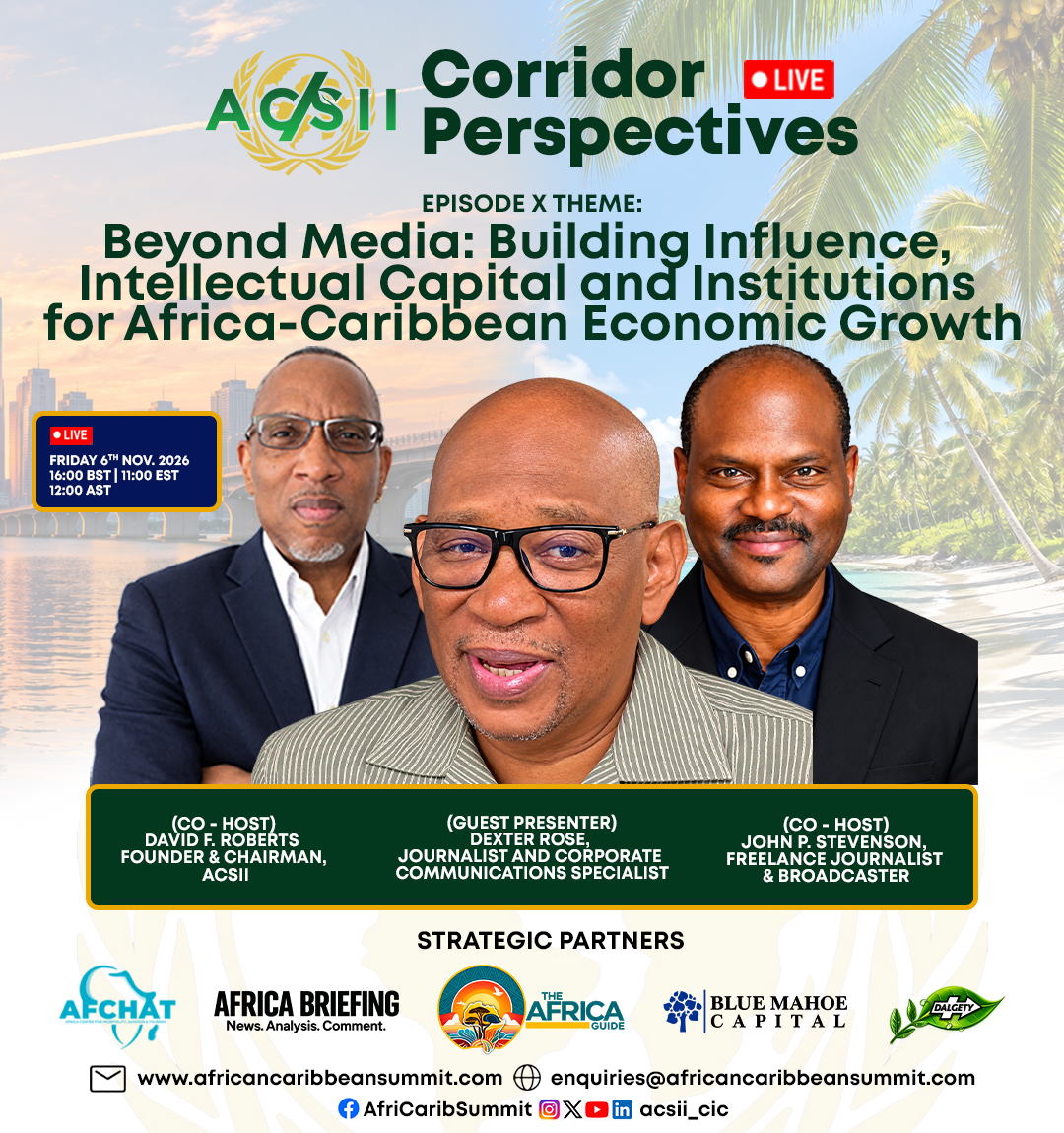
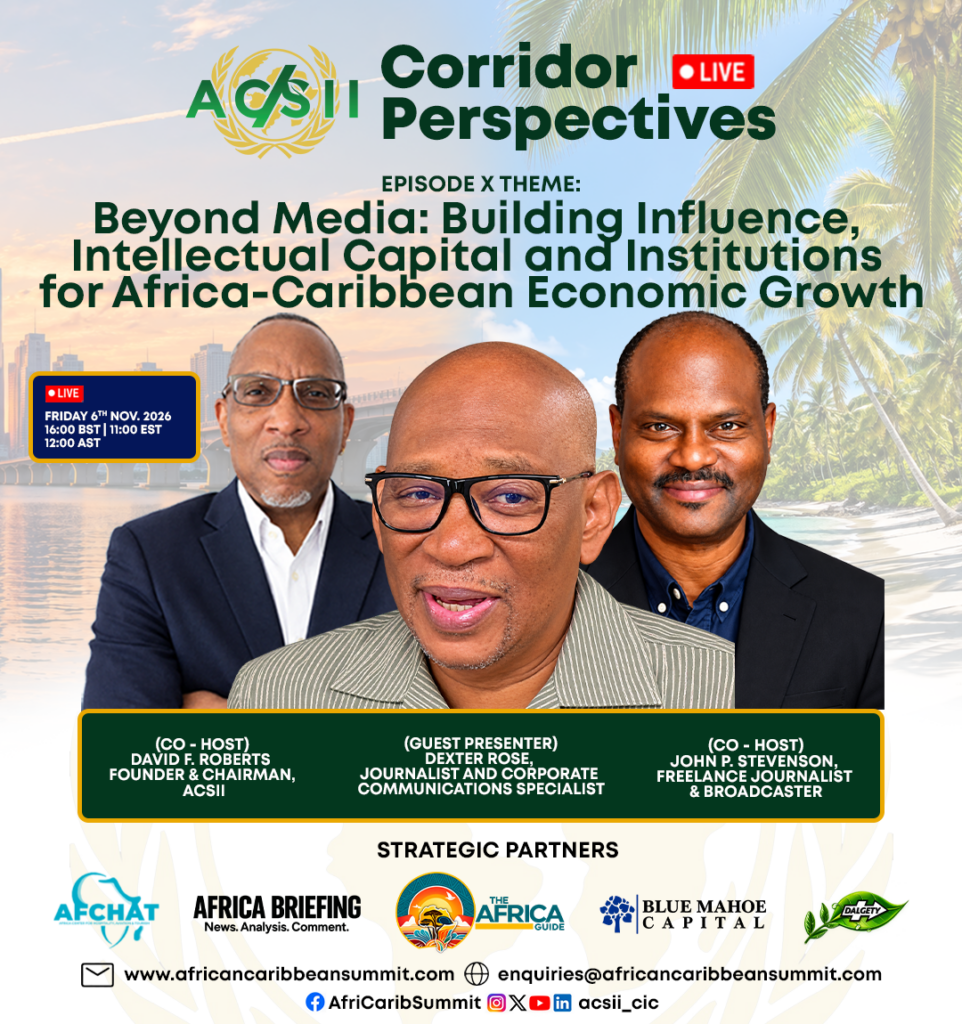
Former diplomat Dexter Rose believes Africa and the Caribbean have spent too long celebrating their shared past without building the commercial relationships their future demands. His concerns extend from colonial attitudes and transport barriers to the institutions needed to make trade work, reports Jon Offei-Ansah.
Keypoints:
- Dexter Rose questions why historical solidarity has produced limited trade
- Transport barriers and inherited perceptions continue to hinder cooperation
- New financing and payment initiatives could improve commercial links
DEXTER Rose knows what it means to cross the Atlantic in search of opportunity. As a young man from St Vincent and the Grenadines, he left New York for a scholarship in Cuba, where he studied alongside Africans, Russians, Koreans and fellow Caribbean students. Years later, he returned to Havana as a diplomat.
Those experiences left him convinced that Africa and the Caribbean have more to gain from one another than their present economic relationship suggests.
Speaking on Corridor Perspectives – LIVE, Rose, a journalist, broadcaster and former ambassador, questioned why regions linked by ancestry, culture and political struggle still find it so difficult to do business together.
His concerns come as African and Caribbean institutions increase efforts to expand trade and investment. A new study estimates that annual commercial opportunities between the regions could reach $1.65bn by 2030. Yet the difficulties Rose identified — expensive transport, unfamiliar markets and lingering suspicion — remain stubbornly familiar.
From Havana to African solidarity
Rose’s connection with Africa began long before his diplomatic career.
He grew up in a politically active family in St Vincent, where African liberation movements and opposition to apartheid were frequent subjects of discussion.
‘I grew up participating in anti-apartheid marches right in St Vincent,’ he recalled.
His education in Cuba deepened that connection. In Havana, he shared classrooms and accommodation with students from several African countries, including Guinea, Mali and Cabo Verde.
He remembered arriving with limited money, little Spanish and considerable curiosity. The experience brought him into contact with people whose backgrounds differed greatly from his own.
It also gave him a lasting appreciation of Cuba’s international relationships.
Rose would eventually serve as ambassador to Cuba from 2005 to 2016, with concurrent diplomatic responsibilities involving Mexico and Iran.
His journalism training proved particularly useful.
‘I was always about the story behind the story,’ he said, explaining why he believed journalists and diplomats needed to question official accounts and understand the interests behind people’s statements.
He praised the intellectual breadth of Cuba’s journalism education but was candid about the limitations of its media system. Asked whether competing editorial viewpoints were encouraged, he replied: ‘Unfortunately, and I’ll tell you right up front, no.’
It was an acknowledgement that his admiration for Cuban education did not extend to every aspect of the country’s political system.
Why African identity still matters
For Rose, Cuba’s involvement in African liberation struggles remains an important part of the Caribbean’s historical relationship with the continent.
He spoke about Cuban military support for Angola and the wider struggle against apartheid, arguing that younger generations should understand the sacrifices made during that period.
‘We in the Caribbean cannot forget where we came from,’ he said.
But the discussion moved beyond historical solidarity when Robert A. Belle, a chartered accountant and finance executive, raised an uncomfortable question about African identity.
Caribbean people mainly are of African descent, but we are taught to see Africa or be identified with Africa in a demeaning way,’ Belle wrote in a comment shared during the programme.
Rose agreed that negative perceptions of Africa remained a problem.
‘There’s a lot of ignorance about Africa,’ he said, recalling encounters with Caribbean people who seemed reluctant to acknowledge their African ancestry.
The issue is hardly straightforward. Caribbean societies have produced generations of writers, artists and political leaders who have celebrated African heritage and challenged colonial ideas about race and identity.
Yet the persistence of negative stereotypes matters, particularly when businesses and professionals are being encouraged to work across unfamiliar markets.
Rose believes the answer lies partly in bringing people together.
‘We have to operate on a cultural level, on a people-to-people level,’ he said.
That may sound simple, but it addresses a practical weakness in the relationship. African and Caribbean entrepreneurs often know more about their traditional trading partners in Europe and North America than they do about potential opportunities across the Atlantic.
The problem of getting there
Rose’s enthusiasm for closer ties is tempered by his experience of the commercial difficulties involved.
‘Africa and Caribbean trade. It’s a dream. It’s a dream,’ he said.
He quickly turned to transport.
For travellers moving between much of the Caribbean and Africa, a journey can still involve connections through Britain or France. Shipping arrangements are equally troublesome for businesses trying to move goods.
Rose recalled the routes used by Cuban aircraft travelling towards Angola, including connections through Guyana and Brazil, and suggested that South America could offer possibilities for improving Atlantic connectivity.
His point was not that the problem had an easy solution. It was that businesses cannot build dependable trade relationships without affordable ways of moving people and products.
‘How are you going to move goods from the Caribbean to Africa?’ he asked.
That question sits at the centre of the latest research.
A November 2026 study by the International Trade Centre and Afreximbank estimates that annual trade potential in goods and services, excluding mineral fuels, could reach $1.65bn by 2030.
Around 80 percent of Africa’s estimated goods export potential to the Caribbean remains untapped. The research also identifies $481m in potential Caribbean services exports.
The opportunities include processed foods, textiles, manufacturing, tourism, transport and creative services.
But exporters face high freight costs, regulatory obstacles, financing difficulties and limited information about prospective partners.
Rose knows something about these pressures from his years working in the Caribbean banana industry.
He recalled how competition and rising production costs forced producers to reconsider their markets and look for alternative sources of income.
It taught him that finding something to sell is only part of the challenge. Getting it to customers at a competitive price can be considerably harder.
Making institutions work for business
Some of the financial obstacles are receiving greater attention.
In February 2026, Afreximbank raised its Caribbean financing ceiling from $3bn to $5bn, building on more than $750m already disbursed across the region.
The expanded financing programme covers infrastructure, tourism, healthcare, agro-processing and other sectors where investment could strengthen regional economies.
CARICOM is also working with Afreximbank on a payments and settlement system. The initiative has entered a pilot phase involving central banks in Barbados, The Bahamas and Trinidad and Tobago, alongside the Eastern Caribbean Central Bank.
According to the CARICOM Secretariat, discussions are continuing over a proposed Caribbean export-import bank that could provide further support for regional commerce.
CARICOM
Rose welcomed such developments but argued that governments must do more to bring businesses together.
‘At the governmental level we got to find ways in which we could negotiate, form joint ventures, invest in Africa,’ he said.
It is a challenge for initiatives such as the developing Africa–Caribbean Trade & Investment Corridor (ACTIC), which seeks to connect investors, businesses and institutions on both sides of the Atlantic.
As Africa Briefing has previously examined, the Africa–Caribbean investment gap goes beyond money. Companies also need trustworthy partners, viable projects and reliable information about markets they hope to enter.
For ACTIC, the measure of progress will be whether its growing network produces businesses that trade, projects that secure financing and partnerships that endure.
Music, journalism and unfamiliar neighbours
Rose’s understanding of diplomacy extends into music.
As host of the Jazz Tropical radio programme, he introduces listeners to jazz from Africa, the Caribbean, Brazil and Latin America, often featuring artists who receive little attention on mainstream radio.
‘This is music by people who don’t get played,’ he explained.
He sees little separation between that work and his efforts to encourage closer international relationships.
Through music, he connects audiences with cultures they may never have encountered directly. Journalism, he believes, should serve a similar purpose.
The discussion raised concerns about how media coverage has shaped Caribbean perceptions of Africa, particularly when stories about the continent concentrate on conflict, poverty and political instability.
Such coverage can leave little room for understanding African enterprise, professional achievement or everyday life.
Rose was particularly concerned about the examples presented to younger people, arguing that successful African entrepreneurs should feature more prominently among the figures they admire.
The point extends beyond representation. Cultural familiarity can encourage people to travel, study, invest and seek business partners in places they might previously have overlooked.
A relationship worth rebuilding
For Rose, the obstacles should not discourage closer cooperation.
‘It’s not impossible,’ he said when discussing the difficulties of moving goods across the Atlantic.
That optimism is understandable. The two regions already possess extensive cultural links, shared historical experiences and growing diplomatic contacts.
What remains less developed is the commercial infrastructure needed to make those relationships economically productive.
As Africa Briefing reported in its examination of trust in Africa–Caribbean trade, confidence between business partners is becoming as important to the emerging corridor as financing and transport.
Rose’s experience offers a useful reminder of how such confidence develops. His years in Havana brought him into contact with African students, journalists and diplomats. Those relationships gave him a familiarity with the continent that formal declarations alone could never provide.
More Africans and Caribbean people will need similar opportunities to know one another, whether through business, education, journalism or cultural exchange.
The history connecting them is unlikely to be forgotten. The more pressing question is whether they can build something economically useful from it.
Next Corridor Perspectives – Live – Series II – Episode XI: “Unlocking Trade, Investment and Business in Zambia”. Guest: H.E. Macenje Mazoka High Commissioner, for Zambia in London. Co-Host: Jonathan Offei-Ansah, veteran journalist & Publisher of Africa Briefing on Friday, November 13th, 2026, at 16:00 GMT | 19:00 EAT | 11:00 EST | 12:00 AST.
Join Corridor Perspectives – LIVE Episode XI on YouTube.
For more articles on Africa: The Africa Briefing – https://africabriefing.com/